Starting an ecommerce business is easier than ever, but choosing the right business model can have a major impact on your long-term success.
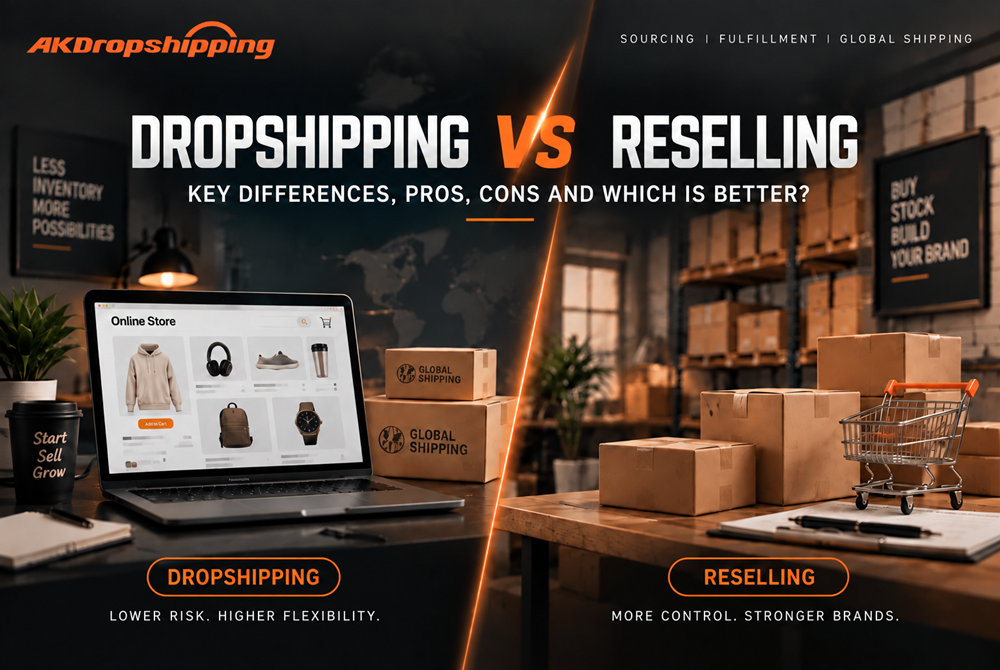
Two of the most popular ways to sell products online are dropshipping and reselling. While both models involve selling products to customers for a profit, they differ significantly in how inventory is managed, how orders are fulfilled, how much money is required to get started, and the level of risk involved.
With dropshipping, you can sell products without purchasing inventory upfront. In contrast, reselling typically requires buying products in advance and storing inventory before making sales.
So, which model is better? The answer depends on your budget, business goals, experience level, and how much control you want over your operations.
In this guide, we'll break down the key differences between dropshipping and reselling, compare their pros and cons, discuss profitability, and explain how AK Dropshipping helps sellers test products, reduce risk, and scale their ecommerce business.
Dropshipping is an ecommerce fulfillment model that allows sellers to sell products without holding inventory themselves. When a customer places an orders, the supplier handles inventory storage, packing, and shipping directly to the customer.
According to Shopify's Dropshipping Guide, this approach allows entrepreneurs to start ecommerce businesses with lower upfront investment because suppliers manage product inventory and fulfillment.
In a dropshipping model, sellers focus on product selection, store management, marketing, and customer acquisition. Meanwhile, suppliers handle the product process after receiving order information.
This model allows sellers to test different products and enter new market without investing heavily in inventory. If a product performs well, sellers can quickly evaluate market demand and scale products. If not, they can switch to another product without being left with unsold stock.
However, supplier reliability is essential because product quality, shipping speed, and inventory accuracy directly influence customer satisfaction.
The main difference between dropshipping and traditional selling is who manages inventory and fulfillment.
In dropshipping, suppliers usually store products, prepare orders, and ship products directly to customers. This significantly reduces operational complexity and startup costs. However, it also means sellers have less direct control over packaging, delivery speed, and inventory availability.
That's why choosing a reliable dropshipiping supplier is critical for long-term success.
Dropshipping generally requires less upfront capital because sellers do not need to purchase inventory before generating sales.
A successful dropshipping store requires product research, ecommerce platform setup, marketing campaigns, customer service, and supplier management. Lower startup costs reduce financial risk, but sellers still need effective strategies to attract customers and build a profitable business.
Reselling is a business model where entrepreneurs purchase products from manufacturers, wholesalers, or distributors and then sell them to customers at a higher price.
Unlike dropshipping, resellers usually own inventory before selling products. This gives them greater control over stock availability, packaging, branding, and fulfillment.
According to Investopedia’s explanation of resale models, reselling involves purchasing products and generating profit by selling them through different channels.
A typical reseller workflow looks like this:
Research products and suppliers
Purchase inventory in advance
Store products in a warehose or fulfillment center
Sell products through ecommerce stores, marketplaces, or retail channels
Pack and ship orders to customers
Because inventory is controlled directly, resellers can create a more consistent customer experience. However, they also assume the risks associated with inventory management and unsold stock.
Inventory ownership creates both opportunities and challenges.
Buying products in bulk can reduce unit costs and improve profit margins. It also allows sellers to control packaging, product quality, and fulfillment speed.
However, upfront purchasing requires more capital and creates inventory risks. If products do not sell as expected, sellers may need to reduce prices or absorb losses.
For this reason, demand forecasting becomes an important part of a successful reselling business.
Resellers can sell products through independent ecommerce stores, marketplaces, social commerce platforms, and offline retail channels.
Fulfillment can be managed internally or through third-party logistics providers (3PLs). Compared with dropshipping, reselling provides more control but requires more operational management.
Dropshipping requires little upfront inventory investment because suppliers hold products until orders are placed. This makes it easier for sellers to test new products and markets.
Reselling requires purchasing inventory in advance, increasing startup costs but providing more control over stock and fulfillment.
Dropshipping suppliers usually manage packing and shipping, while sellers focus on marketing and customer relationships.
Resellers manage fulfillment themselves or through warehouses, giving them more control over delivery speed and packaging but requiring additional resources.
Dropshippers rely more on supplier quality management, making supplier selection especially important.
Resellers typically have greater control because they inspect products before selling them. This can improve consistency and branding.
Dropshipping may have higher per-unit costs but it reduces inventory risk, and allows sellers to invest more flexibility into testing and marketing.
Reselling may achieve better product costs through bulk purchasing. However, storage, inventory, and operational expenses affect final profitability.
Dropshipping offers easier scalability because sellers can add products without purchasing inventory. It is suitable for testing different markets. As reported by Statista's global ecommerce market analysis, global ecommerce continues to grow, creating opportunities for flexible business models that can quickly adapt to market trends.
Reselling can also scale successfully, but it usually requires stronger inventory planning and cash-flow management.
| Factor | Dropshipping | Reselling |
| Inventory Ownership | Supplier-managed | Seller-owned |
| Startup Cost | Lower | Higher |
| Fulfillment | Supplier handles shipping | Seller or warehouse handles shipping |
| Product Control | Limited control over inventory and packaging | Greater control over product quality and branding |
| Inventory Risk | Low | Higher due to unsold stock |
| Scalability | Easier product testing | Requires inventory planning and forecasting |
Dropshipping remains one of the most beginner-friendly ecommerce models because it minimizes financial risk and operational complexity.
Key benefits include:
Lower startup investment
No unsold inventory risk
Easier product testing and market validation
Flexible product selection and business location
Despite its accessibility, dropshipping comes with certain limitations.
Common challenges include:
Less control over fulfillment
Dependence on supplier performance
Potentially lower product margins
More complicated return handling
Reselling offers more control over the customer experience and brand presentation.
Major advantages include:
Greater control over inventory and packaging
Faster fulfillment when inventory is stocked locally
Better customization opportunities
Potentially lower unit costs through bulk purchasing
The biggest challenge with reselling is the upfront investment and operational responsibility.
Potential drawbacks include:
Higher upfront investment
Storage requirements
Risk of unsold inventory
More operational responsibilities
One of the most common questions new ecommerce entrepreneurs ask is whether dropshipping or reselling generates higher profits.
The reality is that profitability depends on much more than product cost. Marketing efficiency, customer acquisition costs, fulfillment expenses, return rates, and operational overhead all influence the final outcome.
Reselling often produces higher gross margins because products are purchased in bulk at lower prices.
However, higher gross margins don't always translate into higher net profits. Storage fees, warehouse expenses, inventory carrying costs, damaged products, and unsold stock can significantly reduce overall profitability.
Dropshipping typically offers lower product margins, but it reduces inventory risk and allows sellers to validate products before committing significant capital.
This is why many successful ecommerce businesses start with dropshipping and transition to bulk purchasing only after demand has been proven.
For example, a product sold for $50 may have different cost structures:
| Cost | Dropshipping | Reselling |
| Product Cost | Higher per unit | Lower through bulk purchase |
| Inventory Cost | Low | Higher |
| Storage Cost | None or minimal | Ongoing warehouse costs |
| Fulfillment Cost | Included through supplier | Managed by seller or warehouse |
| Risk Level | Lower | Higher |
| Scalability | Easier | Requires inventory planning |
The better model depends on overall profitability rather than product cost alone.
Many new sellers focus only on product costs and overlook other expenses that directly affect profitability.
These may include:
Advertising and customer acquisition costs
Payment processing fees
Shipping expenses
Product returns and refunds
Customer support
Inventory storage fees
Time spent managing operations
A product with strong margins on paper may still perform poorly if customer acquisition and fulfillment costs are too high.
The best business model depends on your experience level, available capital, and long-term goals.
Dropshipping may be a better fit if you:
Have a limited startup budget
Want to launch quickly
Are still validating product ideas
Want to test multiple niches
Prefer a lower-risk business model
This approach is especially popular among first-time ecommerce entrepreneurs and Shopify store owners.
Reselling may be the better option if you:
Have sufficient capital to purchase inventory
Already understand market demand
Want greater control over fulfillment
Plan to build a strong branded customer experience
Need faster shipping and inventory control
Many successful ecommerce brands don't choose just one model. Instead, they combine both.
A common strategy is to start with dropshipping to identify winning products and validate demand. Once sales become predictable, sellers purchase inventory in bulk to improve margins, strengthen branding, and gain more control over fulfillment.
This hybrid approach can reduce risk while maximizing growth opportunities.
A reliable supply chain helps ecommerce businesses reduce risks and scale more efficiently. AK Dropshipping provides solutions that support sellers from product testing to long-term brand development.
AK Dropshipping helps sellers identify suitable products and connect with trustworthy suppliers. This allows entrepreneurs to spend more time on marketing and business growth instead of managing complex sourcing processes.
Flexible fulfillment options allow sellers to test products without committing to large inventory purchases. AK Dropshipping's dropshipping fulfillment service helps businesses manage order processing and shipping more efficiently while reducing operational complexity.
Customer satisfaction starts with product quality.
Every order can go through quality inspection procedures to help identify defects, packaging issues, or product inconsistencies before shipment.
This helps reduce disputes, improve customer experience, and protect brand reputation.
Private labeling helps sellers move beyond price competition and build recognizable brands. Customized packaging and branded products can improve customer loyalty.
For businesses looking for a reliable private label supplier, AK Dropshipping provides solutions to support customized ecommerce growth through branded packaging and product customization.
Efficient global shipping helps sellers manage international orders more effectively. Reliable fulfillment and logistics support allow businesses to focus on customer acquisition and scaling.
Both dropshipping and reselling can be successful ecommerce business models, but each serves different business needs.
Dropshipping is ideal for entrepreneurs who want a lower-risk way to test products, enter new markets, and launch online stores with minimal upfront investment.
Reselling offers greater control over inventory, branding, and fulfillment, making it a strong choice for businesses with established demand and sufficient capital.
For many sellers, the most effective strategy is a combination of both models—using dropshipping to validate products and transitioning to bulk purchasing once demand is proven.
With the right supplier, fulfillment partner, and growth strategy, either model can become the foundation of a profitable ecommerce business.
No. Reselling is the broad activity of purchasing a product and selling it to another customer, while dropshipping is a fulfillment method in which the supplier ships the order directly to the buyer. A dropshipper is usually a reseller, but not every reseller uses dropshipping.
In most cases, yes, because dropshippers market products at their own retail prices and earn the difference between revenue and total costs.
The main distinction is that they normally do not receive or store the inventory before it is shipped to the customer.
Dropshipping is often easier for beginners with limited capital because products can be tested without purchasing large quantities in advance.
Reselling may be better for sellers who can manage inventory and want greater control over packaging, delivery speed, and unit economics.
Reselling can provide a lower unit purchase cost through bulk buying, which may improve gross margin.
However, storage, handling, fulfillment, damaged stock, and unsold inventory can reduce net profit, so the complete cost structure must be compared.
Yes. A common growth path is to test products through dropshipping and purchase proven sellers in bulk after demand becomes predictable.
This can improve pricing and fulfillment control while reducing the risk of buying unvalidated inventory.
Yes. A hybrid store can stock predictable bestsellers while dropshipping new, seasonal, or long-tail products.
Clear inventory synchronization and fulfillment rules are necessary so customers receive accurate delivery estimates for each item.