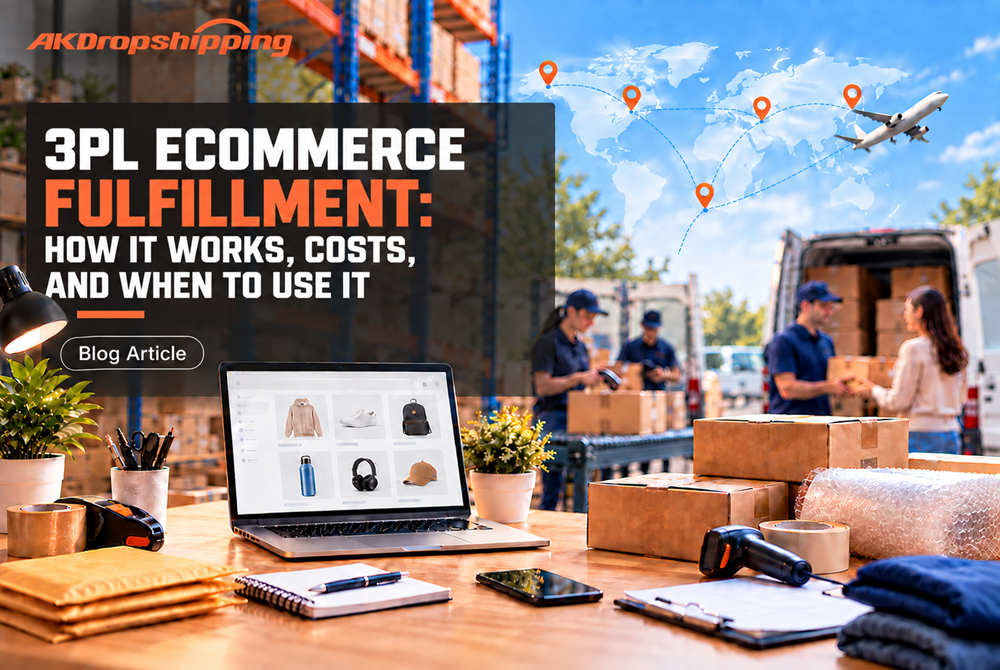
As an online store grows, managing order fulfillment internally quickly turns into a full-time operational headache. Receiving inventory, storing products, processing orders, packing parcels, managing shipping, updating tracking, and handling returns can swallow resources that should be spent on marketing and product development.
That is where Third-Party Logistics (3PL) comes in. Instead of managing every fulfillment task internally, e-commerce brands outsource inventory management and order processing to specialized fulfillment partners.
For brands utilizing 3PL dropshipping as a scaling strategy, the primary question isn't just whether outsourcing is cheaper—it's determining when a 3PL provides enough operational leverage, shipping speed, and accuracy to justify its cost.
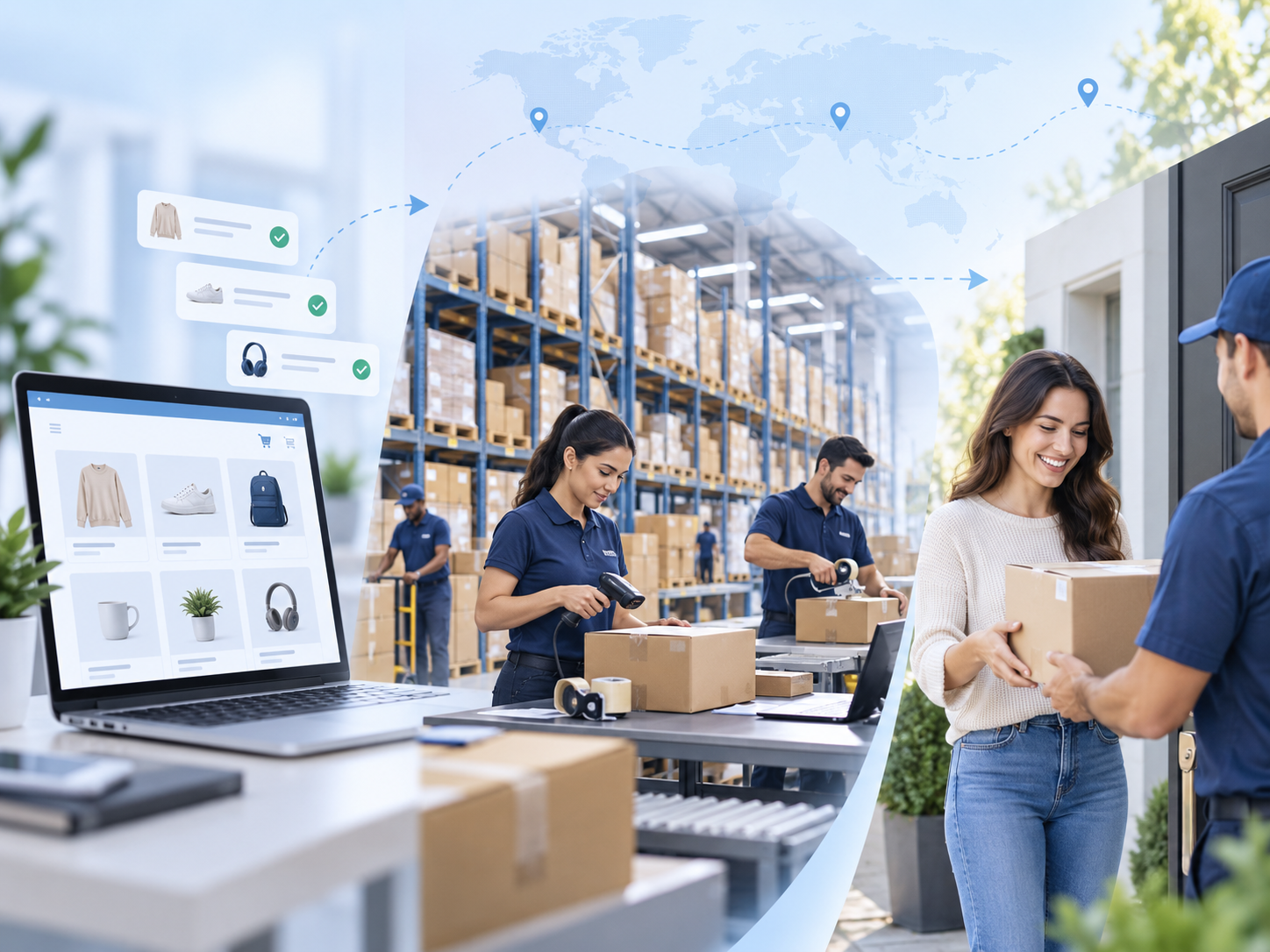
3PL ecommerce fulfillment is the process of outsourcing inventory storage and order fulfillment to a specialized logistics provider.
A third-party logistics provider acts as the operational layer between the ecommerce seller and the final customer. Once inventory reaches the warehouse, the provider handles the physical processes required to turn an online order into a shipped parcel.
The seller remains responsible for product selection, pricing, marketing, customer relationships, and overall business performance.
Most ecommerce fulfillment companies offer a similar group of services, although the exact scope varies by provider.
| Service | Purpose |
| Inventory Receiving | Accept and register inbound inventory |
| Storage | Store products until orders are placed |
| Pick and Pack | Retrieve products and prepare shipments |
| Shipping | Deliver orders through selected carriers |
| Tracking Updates | Synchronize shipment status with stores |
| Returns Processing | Receive and inspect returned products |
| Inventory Reporting | Provide stock visibility and updates |
| Packaging & Kitting | Support branded packaging and bundles |
Some providers also offer value-added services such as custom packaging, private labeling, product bundling, quality inspections, and inventory forecasting support.
The distinction between inventory ownership and operational responsibility is important.
With a conventional 3PL model, the merchant purchases and owns the inventory. The warehouse simply stores and fulfills it.
With dropshipping, the supplier may retain inventory ownership until an order is received. This makes 3PL and dropshipping different models, although they can be combined as a hybrid strategy.
| Benefits | Tradeoffs |
| Less warehouse labor | Receiving and storage fees |
| Faster order processing | Less direct operational control |
| Easier inventory scaling | Provider dependency |
| Access to fulfillment technology | Integration requirements |
| Potentially faster regional delivery | Returns and special handling costs |
A 3PL therefore works best when the value of outsourced operations exceeds the additional service cost.
Modern 3PL fulfillment integrates physical warehouse operations with digital software to create an automated, real-time supply chain.
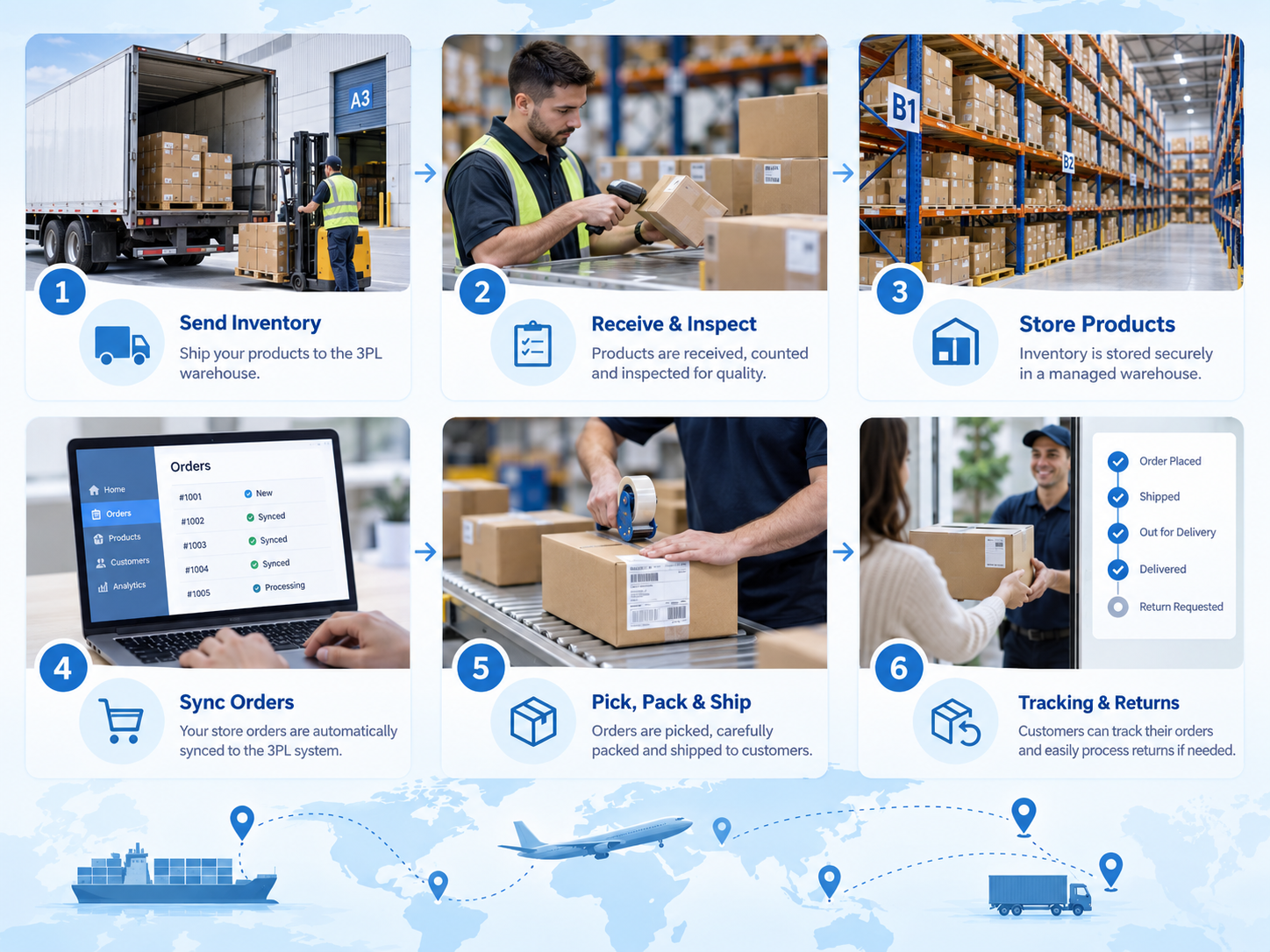
The seller first provides product information, SKU details, quantities, dimensions, and other data required by the fulfillment provider.
Inventory is then shipped to the designated warehouse.
The warehouse receives the shipment and records inventory into its system. Depending on the service, products may also be inspected, labeled, counted, or repackaged.
Accurate SKU mapping at this stage is important because warehouse errors can later become incorrect shipments.
The fulfillment system connects with the seller's ecommerce channels so orders can move automatically from the storefront to the warehouse.
This is particularly important for sellers operating several stores or marketplaces. AK Dropshipping's system supports multiple-store management, automatic order synchronization, inventory management, and automatic tracking updates.
For Shopify sellers, a shopify fulfillment company should therefore be evaluated not only by warehouse capacity but also by the quality of its store integration and order synchronization.
Once an order enters the warehouse system, workers pick the required products and prepare the parcel.
Depending on the service, sellers may use standard packaging or add branded boxes, inserts, labels, bundles, and other customized elements.
The fulfillment provider selects a shipping route based on destination, delivery requirements, product characteristics, and available logistics options.
Tracking information should then be synchronized with the ecommerce store so customers can monitor delivery progress.
This part of fulfillment has become increasingly important. DHL's 2026 ecommerce research found that 67% of online shoppers had abandoned a cart because of the delivery offering, showing why shipping cost, speed, and clarity can influence conversion.
Returns require the warehouse to receive the parcel, inspect its condition, update inventory, and follow the seller's refund, replacement, restocking, or disposal rules.
A strong return process prevents returned inventory from disappearing from stock records.
| Stage | Main Responsibility | Output |
| Inventory Inbound | Warehouse | Stock received |
| Inspection | Warehouse | Verified inventory |
| Storage | 3PL | Available stock |
| Order Sync | System | Fulfillment order |
| Pick & Pack | Warehouse | Prepared parcel |
| Shipping | Carrier/3PL | Shipment |
| Tracking | System | Customer tracking |
| Returns | 3PL + seller | Reconciled inventory |
3PL ecommerce fulfillment cost is the combined expense of receiving, storing, handling, packing, shipping, and managing inventory and returns.
Some providers charge for unloading, counting, labeling, SKU registration, pallet handling, or other inbound services.
The pricing method can vary significantly, so sellers should ask whether receiving is charged per shipment, carton, pallet, unit, or labor hour.
Storage may be calculated according to pallet positions, bins, shelves, cubic feet, or another warehouse unit.
A low storage rate does not necessarily mean a low total fulfillment cost. If products require frequent handling, the pick-and-pack charges may become more significant.
Pick-and-pack fees normally cover the labor required to retrieve products and prepare orders.
Additional charges may apply to multiple-item orders, special packaging, inserts, bundles, fragile products, oversized items, or other handling requirements.
Shipping is often one of the largest components of fulfillment cost.
Actual weight, dimensional weight, destination, shipping method, fuel surcharges, remote-area fees, and peak-season charges can all influence the final amount.
Some providers also charge account management fees, minimum monthly fees, return processing fees, or long-term storage charges.
Before signing a contract, sellers should request a complete rate card rather than comparing only storage or pick-and-pack prices.
Instead of comparing only storage or shipping fees, sellers should calculate:
Total Fulfillment Cost Per Order = Receiving Allocation + Storage Allocation + Pick & Pack + Packaging + Shipping + Returns Allocation + Other Applicable Fees
This provides a more accurate basis for comparing providers.
Ask each provider to quote the same product, order profile, destination, packaging requirements, and monthly volume.
For example, if one provider offers cheaper storage but significantly higher shipping or handling costs, its total cost per shipped order may still be higher.
3PL, self-fulfillment, and dropshipping solve different operational problems, so the right choice depends on inventory ownership, order volume, control requirements, and cash flow.
| Factor | Self-Fulfillment | 3PL | Dropshipping |
| Inventory | Seller-owned | Seller-owned | Usually supplier-held |
| Upfront Capital | Higher | Higher | Lower |
| Warehouse Management | Seller | 3PL | Supplier |
| Operational Workload | High | Medium | Lower |
| Packaging Control | High | Medium to high | Depends on supplier |
| Scalability | Requires infrastructure | Easier | Flexible |
| Inventory Risk | High | High | Lower |
| Delivery Control | High | High | Varies |
Self-fulfillment can work well when:
Order volume is relatively low
Storage requirements are manageable
The owner wants maximum control
It may also make sense for products requiring highly specialized handling that a standard fulfillment provider cannot easily support.
Dropshipping can be suitable when:
Testing new products
Minimizing inventory investment
Expanding product catalogs quickly
Validating demand before purchasing stock
The tradeoff is reduced control over inventory availability and fulfillment operations.
A 3PL becomes more attractive when:
Order volume is growing
Warehouse work consumes significant time
Faster shipping is required
Inventory complexity increases
Multi-channel fulfillment becomes difficult to manage internally
A hybrid model can combine the flexibility of dropshipping with the control of pre-stocked fulfillment.
For example, a seller can dropship newly tested products and place proven bestsellers into a warehouse. This reduces the risk of purchasing unvalidated inventory while allowing high-demand products to be processed faster.
This approach is particularly relevant to 3PL dropshipping, where the seller uses outsourced inventory and fulfillment infrastructure while maintaining a flexible product-testing strategy.
A 3PL may not be appropriate when order volume is very low, demand is unpredictable, margins are too narrow to absorb fulfillment fees, or the products require specialized handling that the provider cannot support.
Choosing a 3PL ecommerce fulfillment partner requires evaluating the entire operating system rather than just the warehouse.
Warehouse location affects delivery time, shipping cost, and inventory positioning.
For international sellers, multiple regional fulfillment options can be valuable. A 3PL with warehouses positioned close to major customer markets can help reduce transit distances and improve delivery consistency. When comparing providers, consider warehouse coverage, inventory transfer options, carrier availability, and whether stock can be distributed across multiple regions as order volume grows.
Confirm that the provider supports the platforms you actually use.
For example, sellers using WooCommerce should check whether the provider supports order fulfillment services for woocommerce, including automatic order import, inventory synchronization, tracking updates, cancellations, and returns.
Ask about order accuracy, processing cutoffs, inventory updates, and average processing times.
A provider with good technology but poor warehouse execution can still create customer-service problems.
Request a complete quotation covering receiving, storage, picking, packaging, shipping, returns, account fees, and special handling.
If building a long-term ecommerce brand, confirm whether the provider can support custom packaging, labels, inserts, bundles, and private-label products.
AK Dropshipping currently supports custom packaging, branding, private labeling, and related fulfillment services.
A fulfillment problem can quickly become a customer-service problem. Ask how damaged packages, missing items, failed deliveries, refunds, and reshipments are handled.
Before moving all inventory, send a limited quantity and test receiving, order processing, packaging, tracking, delivery, and returns.
A practical checklist should cover:
Warehouse location and capacity
Ecommerce integrations
Inventory visibility
Order accuracy
Processing speed
Complete pricing
Shipping options
Packaging and branding
Returns management
Customer support
Claims procedures
Contract flexibility
3PL ecommerce fulfillment is increasingly influenced by delivery expectations, multi-channel selling, warehouse technology, and automation.
Customers increasingly treat delivery as part of the buying experience. Faster processing and strategically located inventory can therefore influence conversion and retention.
Ecommerce sellers increasingly operate across websites, marketplaces, and social commerce channels. A fulfillment system needs to keep orders and inventory synchronized across these channels.
In 2026, logistics technology is moving further toward automated workflows, real-time visibility, and AI-assisted operations.
A recent McKinsey analysis published in September 2026 notes that AI-enabled tools, digital twins, and visibility platforms are moving toward the core of logistics operations as companies respond to labor, capacity, and productivity pressures.
Fulfillment is no longer limited to moving boxes. Packaging, inserts, product bundles, and private labeling can become part of the customer experience.
Many ecommerce sellers do not need to choose between pure dropshipping and full inventory ownership. A hybrid model allows businesses to test products through dropshipping and pre-stock proven products for faster fulfillment.
AK Dropshipping provides an end-to-end supply chain infrastructure designed to take online stores from initial product testing to scaled bulk fulfillment.
Fulfillment starts with reliable products. We source products directly from verified manufacturers, conducting physical quality control inspections before stock reaches warehouse shelves.
This gives sellers an operational bridge between product testing and inventory-based fulfillment and reduce the risk of defective products entering sellable inventory.
We promote free warehousing with no stated time limit for stored products. Its warehouse system is designed to help sellers prepare inventory and maintain fulfillment continuity.
This can be useful for sellers who want to pre-stock proven products without immediately adding conventional monthly storage costs.
AK's automated system supports:
Multi-store management
Automatic order synchronization
Product mapping
Inventroy management
Tracking-number synchronization
This reduces repetitive manual work and allows sellers to manage fulfillment from a centralized system.
We help sellers transform generic products into authentic branded assets by offering custom poly mailers, private labeling, promotional inserts, and custom kitting options.
This allows fulfillment to become part of the brand experience rather than simply a back-end shipping function.
AK Dropshipping offers multiple shipping routes and carrier options for different destinations and delivery requirements.
Sellers can choose shipping methods based on cost, speed, and target market requirements.
A practical growth path is to test products through dropshipping, identify consistent sellers, purchase inventory for proven products, and then use warehousing and fulfillment infrastructure to improve processing and delivery consistency. This gives ecommerce sellers a way to scale without committing every product to inventory at the beginning.
3PL ecommerce fulfillment allows online businesses to outsource warehousing and order processing while maintaining control over products, pricing, and customer relationships.
The right fulfillment strategy depends on order volume, inventory ownership, delivery expectations, operational complexity, and business goals. For some sellers, self-fulfillment remains sufficient. Others may benefit from dropshipping, while growing businesses often find that 3PL fulfillment provides the infrastructure needed to scale efficiently.
Many ecommerce brands ultimately adopt a hybrid approach—testing products through dropshipping while pre-stocking proven bestsellers for faster and more consistent fulfillment.
By combining sourcing, quality inspection, warehousing, order fulfillment, branding, and global shipping, AK Dropshipping helps sellers move from product testing to scalable fulfillment without building their own logistics operation.
3PL means third-party logistics. In ecommerce, a 3PL stores a merchant's inventory, receives orders from connected sales channels, picks and packs products, ships them to customers, updates tracking, and may process returns. The merchant owns the inventory, while the provider manages day-to-day fulfillment operations.
No. With 3PL fulfillment, the merchant usually purchases and owns inventory before storing it in a warehouse. In dropshipping, the supplier generally holds the stock and ships after a customer places an order. A hybrid model can combine both approaches.
Costs vary by product, order volume, warehouse location, shipping destination, and service level. Common charges include receiving, storage, pick and pack, packaging, shipping, returns, software, and account fees. Compare providers using total cost per shipped order.
There is no universal threshold. A 3PL becomes more useful when demand is predictable, warehouse work consumes significant staff time, storage becomes difficult, fulfillment errors increase, or faster regional delivery is required.
Many providers support major ecommerce platforms through native integrations or APIs. Confirm that the connection supports automatic order import, inventory synchronization, tracking updates, product mapping, cancellations, split shipments, and returns.
Ask about warehouse locations, integrations, receiving times, order cutoffs, accuracy, inventory reporting, carrier options, pricing, minimums, packaging, returns, claims, support, and contract terms. A small-scale test can also reveal how well the provider handles real orders.