Setting the right price is one of the most important decisions in any dropshipping business. Price affects conversion rates, profit margins, advertising performance, and long-term scalability.
Many beginners simply 2x or 3x their supplier cost and hope the numbers work out. However, profitable dropshipping pricing requires a deeper understanding of all the costs involved in fulfilling an order.
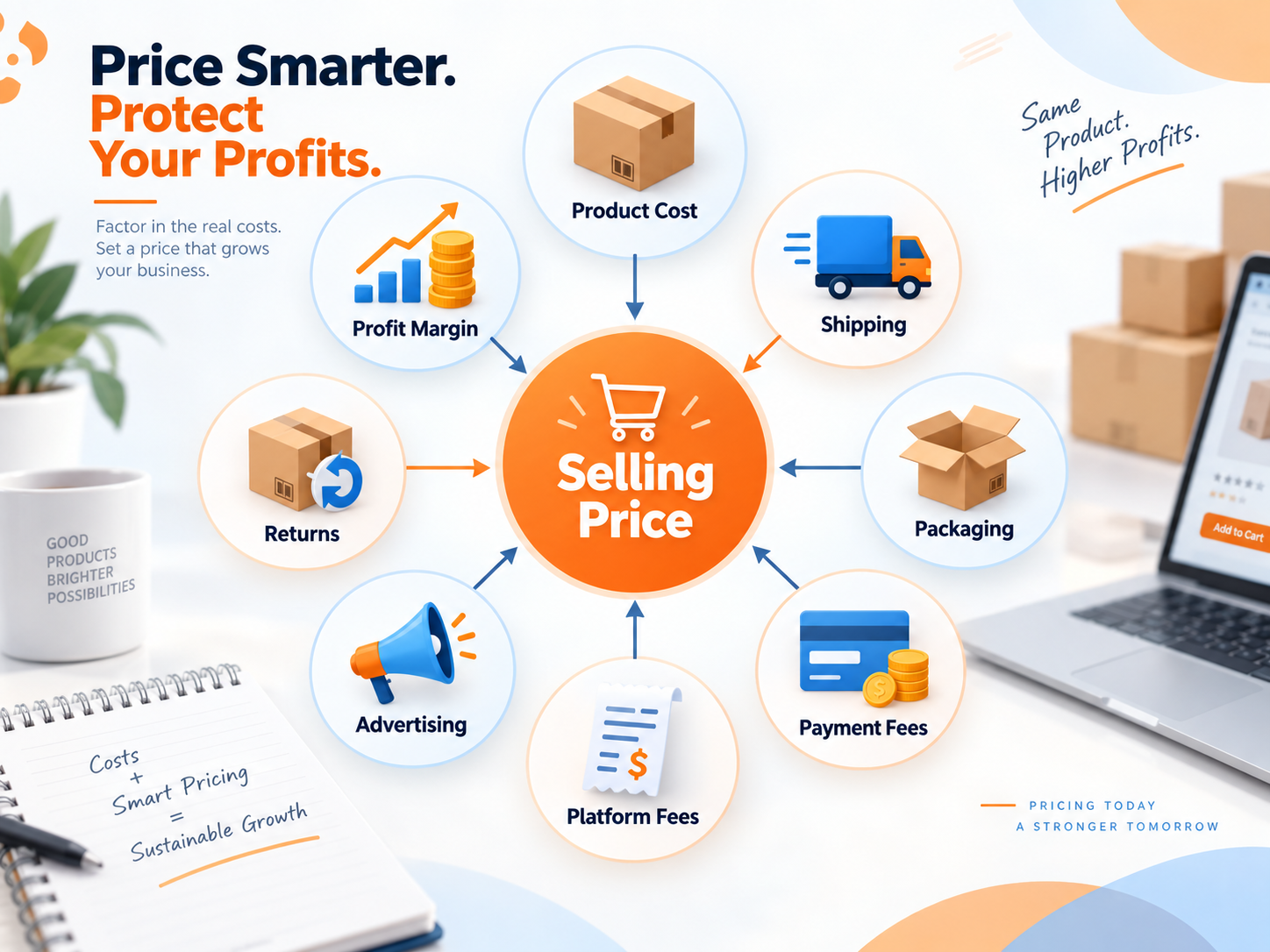
Besides product cost, sellers must consider shipping fees, payment processing charges, advertising costs, refunds, platform fees, and promotional discounts. A product that appears profitable on paper can quickly become unprofitable once these expenses are included.
The goal is not to find the highest possible selling price. The goal is to find a price that customers are willing to pay while leaving enough margin to support sustainable growth.

A profitable price should cover all direct and indirect costs while generating enough margin to support marketing, operations, and future growth.
For dropshipping stores, profitability is usually determined by three factors:
Product and fulfillment costs
Customer acquisition costs (CAC)
Target profit margin
A product that generates sales but leaves little profit after advertising expenses may not be worth scaling.
There is no universal profit margin that works for every store.
According to Shopify's guide on dropshipping profitability, many successful dropshipping businesses target gross margins between 20% and 50%, although actual profitability varies significantly by niche, competition, and advertising efficiency.
A reasonable target depends on:
Product category
Shipping costs
Advertising costs
Return rates
Customer lifetime value
Competitive pricing pressure
Markup measures profit relative to product cost, while profit margin measures profit relative to selling price. These two figures should not be treated as interchangeable.
For example:
| Metric | Formula | Result |
| Product Cost | / | $20 |
Selling Price | / | $30 |
| Gross Profit | $30-$20 | $10 |
| Markup | $10÷$20 | 50% |
| Gross Margin | $10÷$30 | 33.3% |
This difference is important because pricing based only on markup may not generate the margin required to cover advertising and operational expenses.
Many dropshippers celebrate a high gross margin only to find their bank account empty at the end of the month. To price correctly, you must distinguish between these core financial metrics:
| Metric | Basic Meaning | Main Use |
| Markup | Profit ÷ Cost | Setting an initial price |
| Gross Margin | Gross Profit ÷ Revenue | Measuring product-level profitability |
| Contribution Margin | Revenue minus variable costs | Evaluating orders and advertising |
| Net Profit | Revenue minus all business expenses | Measuring overall business performance |
Doubling or tripling product cost can be a useful starting point, but it does not account for shipping, payment charges, advertising, returns, taxes, discounts, or other operating costs. A product that appears profitable at 2x supplier cost may generate very little contribution once customer acquisition and fulfillment expenses are included.
A multiplier is therefore better treated as an initial reference than as a complete pricing strategy.
Pricing affects more than the amount earned from each order. A higher price may increase contribution per sale but reduce conversion, while a lower price may increase conversion but leave less room for advertising and fulfillment costs.
The practical objective is to find a price that balances customer willingness to pay with the contribution margin required to operate the business.
Before setting a selling price, sellers should calculate the complete variable cost of an order instead of comparing the retail price only with the supplier quotation.
The starting point is the supplier quotation, including:
Product cost
Supplier service fees
Sourcing costs
Product-specific expenses
Supplier pricing can change over time, making regular reviews important for maintaining profitability.
Additional fulfillment costs may include:
Product sourcing
Quality inspection
Picking and packing
Packaging materials
Product inserts
Labels and branding materials
Although these costs may seem small individually, they can significantly affect margins as order volume grows.
Shipping is often one of the largest costs in dropshipping.
Sellers should consider:
Package weight
Dimensional weight
Shipping destination
Customs duties
Import taxes
Delivery surcharges
Reshipment costs
Unexpected shipping costs can also affect conversion rates. According to Ryder's 2026 E-Commerce Consumer Study, unexpected shipping charges remain one of the leading causes of cart abandonment.
Most stores incur transaction-related expenses, including:
Payment processing fees
Marketplace commissions
Platform transaction fees
Currency conversion fees
These costs should be included in pricing calculations rather than treated as afterthoughts.
For sellers operating through WooCommerce, Shopify, or marketplaces, platform-related costs can have a meaningful impact on contribution margin.
Advertising should be treated as part of product economics. If an average order requires $8 in advertising expenditure, that amount needs to be included when determining whether the remaining contribution is sufficient.
A product with a $12 gross profit may look attractive before advertising but become marginal after customer acquisition costs are included.
Returns and failed deliveries create costs that may not appear in the initial order calculation. A more realistic pricing model should include an expected allowance for refunds, replacements, chargebacks, and reshipments.
For U.S. online sellers, delivery promises also need to be supported by a reasonable basis. The FTC's Mail, Internet, or Telephone Order Merchandise Rule establishes requirements concerning shipping representations and delayed orders, including appropriate cancellation and refund procedures.
Software subscriptions, customer support, and other operating expenses can also affect profitability. They may not be directly attributable to a single order, but sellers can allocate a reasonable share of recurring expenses across monthly order volume.
Choosing a suitable Dropshipping Automation App can also help sellers manage repetitive tasks more efficiently, but software costs should still be included in the overall operating-cost calculation.
A practical order-level cost model can include product cost, sourcing, inspection, fulfillment, packaging, shipping, payment fees, advertising, expected returns and refunds, and other variable charges.
This total provides the cost baseline needed before setting a selling price.
Add product, fulfillment, packaging, and expected shipping costs first. This establishes the fixed cost component before percentage-based fees are applied.
Payment processing, marketplace commissions, platform charges, and similar fees may be calculated as a percentage of selling price. These costs should be incorporated into the pricing formula rather than added after the price has already been established.
Set a contribution margin that leaves enough room for advertising, discounts, returns, and other operating expenses. The target should reflect the actual economics of the business rather than an arbitrary industry percentage.
A practical formula is:
Minimum Selling Price = Order-Level Costs ÷ (1 − Percentage Fees − Target Contribution Margin)
For example:
Order-level costs: $20
Percentage Fees: 10%
Target contribution margin: 30%
Minimum selling price=$20÷(1-0.1-0.3)=$33.3
This provides a minimum pricing threshold before market considerations are applied.
Pricing should not be based solely on cost.
Analyze:
Competitor pricing
Product features
Customer reviews
Delivery times
Brand positioning
Customer expectations
A product that solves an important problem may justify a significantly higher price than a similar product with weaker perceived value.
Many sellers choose between:
Free Shipping Model
Shipping cost included in product price
Simpler customer experience
Often improves conversion rates
Separate Shipping Model
Lower product price
Shipping charged during checkout
May increase cart abandonment if shipping appears unexpectedly
Testing both approaches can help identify the most profitable structure for your audience.
Create different scenarios using changes in shipping cost, advertising expenditure, conversion rate, return rate, and average order value. This helps determine whether a product can remain viable when operating conditions change.
Understanding break-even metrics helps sellers make better advertising decisions.
Break-Even CPA (Cost Per Acquisition) shows the maximum amount that can be spent to acquire a customer before profit reaches zero.
Break-Even ROAS (Return on Ad Spend) indicates the minimum advertising performance needed to remain profitable.
These benchmarks become increasingly important as advertising budgets scale.
The following example demonstrates a simple pricing calculation:
| Item | Example |
| Product + Fulfillment | $14 |
| Shipping | $6 |
| Payment/Platform Fees | 10% |
| Target Contribution Margin | 30% |
| Minimum Selling Price | $33.33 |
Whenever supplier costs, shipping rates, advertising expenses, or payment fees change, sellers should recalculate pricing to maintain profitability.
Cost-plus pricing is straightforward when product and fulfillment costs remain relatively stable. It provides a clear starting point, although it does not automatically account for customer-perceived value or competitive positioning.
Competition-based pricing can be useful when customers can easily compare similar products. However, competitors may have different supplier costs, shipping arrangements, traffic sources, and advertising economics, so matching their price does not necessarily produce the same margin.
When a product offers stronger design, functionality, branding, content, or service, its price can be based more heavily on perceived customer value rather than supplier cost alone.
Bundles and quantity-based offers can increase average order value while spreading shipping and acquisition costs across multiple products. This can create additional contribution without relying entirely on a higher single-unit price.
Free shipping can simplify the buying decision, while separate shipping can keep the displayed product price lower. The appropriate structure depends on the product, destination, average order value, and customer expectations.
Prices such as $29.99, reference prices, and compare-at pricing can influence how customers perceive an offer. These techniques should support a genuine value proposition rather than compensate for an economically weak product.
| Strategy | Best Use | Main Benefit | Main Risk |
| Cost-plus | Stable products | Simple calculation | Ignores market value |
| Competition-based | Comparable products | Market alignment | Margin pressure |
| Value-based | Differentiated products | Greater pricing flexibility | Requires stronger positioning |
| Bundle pricing | Multi-item orders | Higher AOV | More complex fulfillment |
A low-differentiation product may require closer attention to competing prices, while a differentiated product can support more value-based pricing. Paid traffic also requires careful margin control because customer acquisition costs can change significantly between campaigns and markets.
Setting the right price is only the beginning. To maintain profitability, sellers should continuously monitor costs and performance.
Define the lowest acceptable selling price before launching promotions. This prevents aggressive discounts from pushing contribution margin below the level required to cover variable costs.
A product can perform differently across countries because shipping, advertising, taxes, payment fees, and customer behavior vary. Tracking contribution margin by SKU, market, channel, and campaign provides a clearer picture than using one average margin for the entire store.
Advertising decisions should remain connected to unit economics. When actual CPA approaches the break-even threshold, sellers can reassess the product price, advertising creative, targeting, or offer structure.
Not every product needs to be offered under identical shipping conditions in every market. Different shipping options or destination coverage can help prevent expensive delivery costs from consuming the product margin.
Supplier negotiations can become more important as order volume increases. Package dimensions should also be reviewed because reducing dimensional weight can lower shipping expenses without changing the product itself.
Quality inspection and better packaging can reduce avoidable post-purchase costs. Lower defect and return rates protect contribution margin while also improving the customer experience.
A price that was profitable several months ago may no longer provide the same margin after changes in supplier costs, shipping rates, exchange rates, taxes, payment fees, or advertising expenses.
Price changes should be evaluated using sufficient order and traffic data. Looking only at short-term conversion changes can hide the effect on CPA, average order value, refund rate, and contribution margin.
A useful pricing dashboard can track selling price, contribution margin, conversion rate, CPA, ROAS, shipping cost, refund rate, and average order value. Price reviews can then be triggered by meaningful changes instead of daily fluctuations.
Supplier sourcing and quotation comparison establish the product-cost baseline before a seller decides how much to charge. Accurate supplier costs are essential because every later pricing calculation depends on this starting point.
Looking at product, fulfillment, and shipping costs before launch makes it easier to identify products that would require an unrealistic retail price to generate a sustainable margin.
Quality inspection can reduce avoidable defects and the associated costs of refunds, replacements, and reshipments. These costs are particularly important when calculating the real contribution margin of a product.
Packaging dimensions can directly affect shipping economics. Optimizing packaging can therefore reduce costs that might otherwise remain hidden when sellers compare only the supplier's product quotation.
Different destinations may require different shipping solutions. Matching shipping options with the target market allows sellers to balance delivery expectations, customer experience, and product economics.
Selling internationally often means dealing with multiple currencies, payment methods, and transaction costs. AK Dropshipping has integrated Antom into the platform, giving sellers access to a wider range of local payment methods across different markets. By supporting customers' preferred payment options, sellers can improve the checkout experience while managing cross-border transactions more efficiently.
Rather than investing heavily in inventory immediately, sellers can test products through dropshipping, validate demand, and then scale proven products through bulk purchasing or cloud warehousing when appropriate.
Profitable dropshipping pricing involves more than applying a simple markup to supplier costs. Product cost, fulfillment, shipping, payment fees, advertising, returns, taxes, and discounts can all influence the contribution generated by each order. Sellers should calculate a minimum sustainable price, compare it with market expectations, and continue monitoring contribution margin after launch.
By choosing the right pricing strategy, monitoring margins regularly, and controlling fulfillment costs, ecommerce businesses can build a pricing structure that supports sustainable growth. Working with a reliable partner such as AK Dropshipping can further help sellers improve cost control, streamline operations, and protect long-term profitability.
There is no universal good margin. A sustainable target must cover product, fulfillment, shipping, payment and platform fees, advertising, returns, and overhead while remaining competitive. Contribution margin should be monitored by SKU and market rather than copied from a general industry percentage.
Calculate your total order-level costs, including product cost, fulfillment, shipping, and fees. Then add a target profit margin.
A simple formula is:
Selling Price = Order-Level Costs ÷ (1 − Fees − Target Margin)
After calculating a minimum profitable price, compare it with competitor pricing and customer expectations before setting your final selling price.
No. Doubling or tripling product cost ignores shipping, platform fees, payment charges, advertising, returns, taxes, and discounts. A multiplier can be a starting point, but the final price should come from complete unit economics and market testing.
Markup measures profit relative to cost, while margin measures profit relative to selling price. A product costing $20 and selling for $30 has a 50% markup but a 33.3% gross margin.
Either approach can work. Shipping can be included in the displayed product price or charged separately, but the expected shipping expense should always be included in the profitability calculation. Destination-specific shipping costs, surcharges, failed deliveries, and reshipments should also be considered.
Review prices when supplier quotations, shipping rates, exchange rates, payment fees, advertising costs, taxes, refund rates, or competitor conditions change. Avoid reacting to short-term fluctuations without enough order and conversion data to evaluate the actual effect.