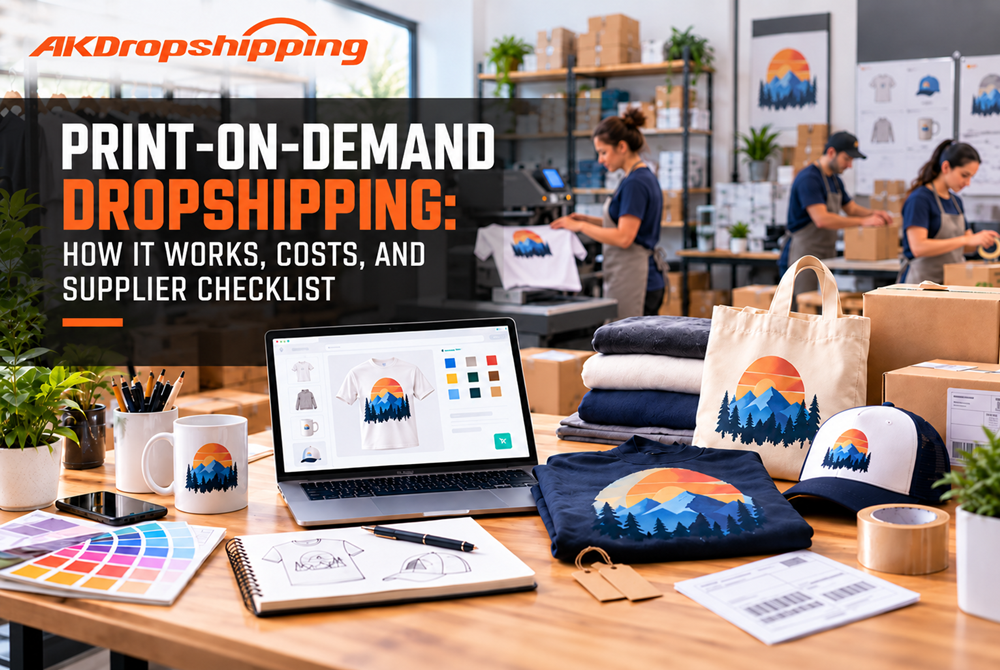
Print-on-demand dropshipping combines product customization with an order-based fulfillment model. Instead of purchasing large quantities of finished products before knowing what customers will buy, sellers can list customized products first and have them produced or prepared after an order is received. This makes the model attractive for creators, niche ecommerce brands, and sellers testing new product ideas without committing heavily to inventory.
However, POD is not simply a matter of uploading a design and waiting for sales. Product selection, printing technology, sample approval, fulfillment cost, packaging, shipping, returns, and supplier reliability all affect the actual economics of the business. This guide explains how print-on-demand dropshipping works, what it costs, how to evaluate suppliers, and how AK Dropshipping can support sellers moving from product testing toward branded fulfillment.
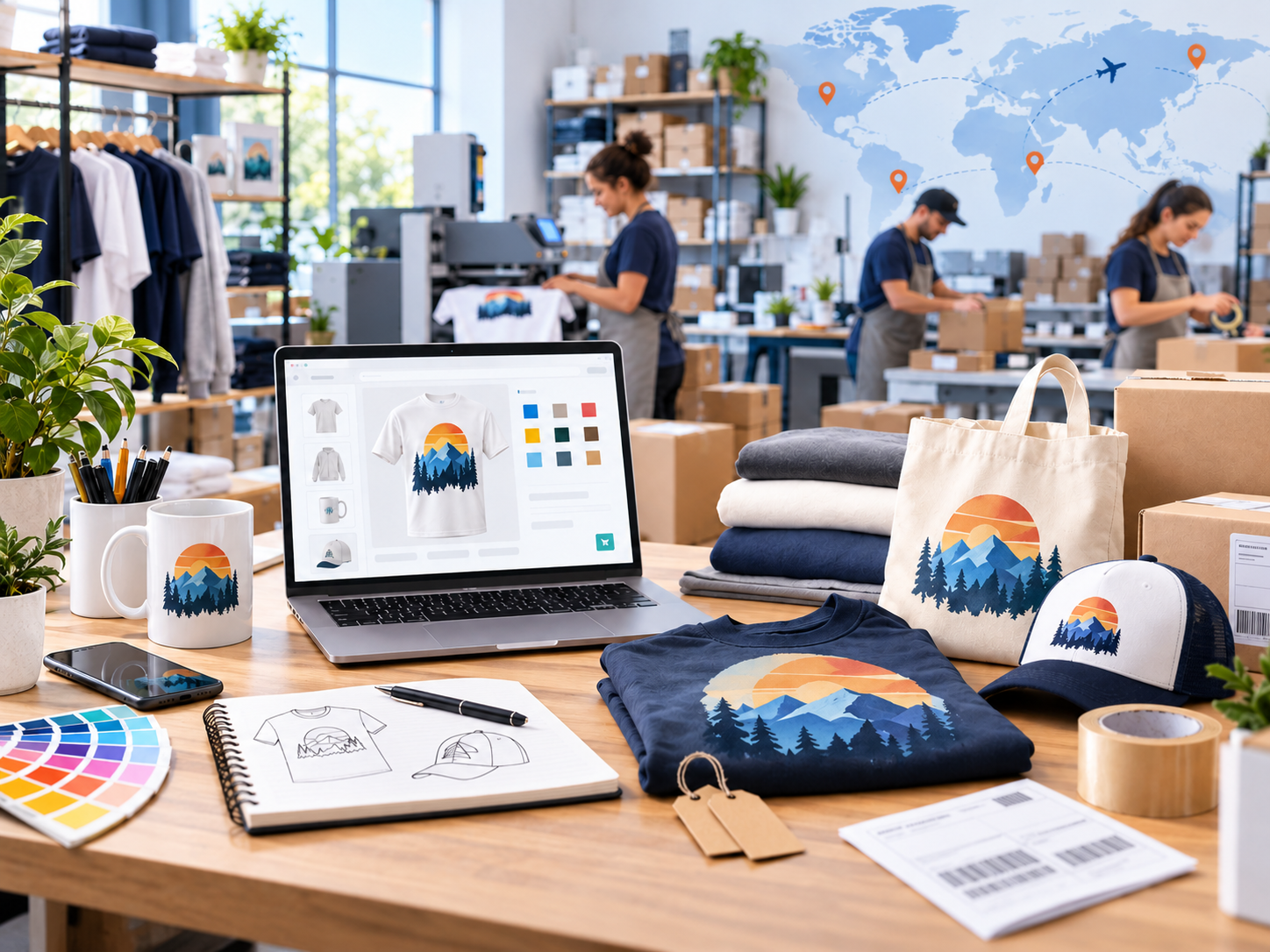
Print-on-demand dropshipping connects product customization with order-based fulfillment. Sellers can offer customized products without holding large quantities of finished inventory. When an order is received, the supplier produces or customizes the item, then handles packing and shipment according to the agreed specifications.
The model works particularly well for products where design adds value, including printed apparel, personalized accessories, home décor, and branded merchandise. Sellers can test individual designs without committing heavily to inventory. This also fits growing demand for relevant, personalized experiences, which is highlighted in Forrester's 2026 research on consumer personalization.
For this reason, print-on-demand dropshipping is often used to test new designs, serve niche audiences, launch seasonal collections, and validate products before moving successful items into larger-scale inventory or private-label production.
Traditional dropshipping usually involves an existing product that the supplier already keeps in stock. The seller markets the product, receives an order, and the supplier ships the selected item.
POD adds a customization or production stage. A blank garment, accessory, home product, or other base item may be printed, embroidered, engraved, or otherwise customized after the order arrives.
The additional production step creates more opportunities for differentiation, but it can also introduce production time, customization charges, quality-control requirements, and higher per-unit costs.
POD and private label are related but serve different operating models. POD is generally designed around made-to-order customization, while private label can involve developing branded products and purchasing inventory in larger quantities.
For a new seller, POD can provide a way to test a concept before moving proven products into a more inventory-intensive private-label model. Once demand becomes predictable, a seller may consider bulk purchasing, branded packaging, custom labels, or pre-stocked inventory to improve unit economics.
| Factor | Benefits | Limitations |
| Inventory | Low upfront inventory commitment | Higher per-unit costs |
| Product Testing | Easy to test new designs and niches | Sample approval is still necessary |
| Customization | Strong branding and personalization opportunities | Print quality depends on production method |
| Fulfillment | Production and shipping handled by suppliers | Less direct control over operations |
| Scalability | Launch new products without inventory investment | Production capacity may become a constraint |
| Risk | Lower risk of unsold inventory | Defects, reprints, and returns can reduce margins |
For many sellers, POD is an effective way to enter ecommerce with lower inventory risk while building a unique brand. The key is choosing reliable products, maintaining quality standards, and working with suppliers that can support long-term growth.
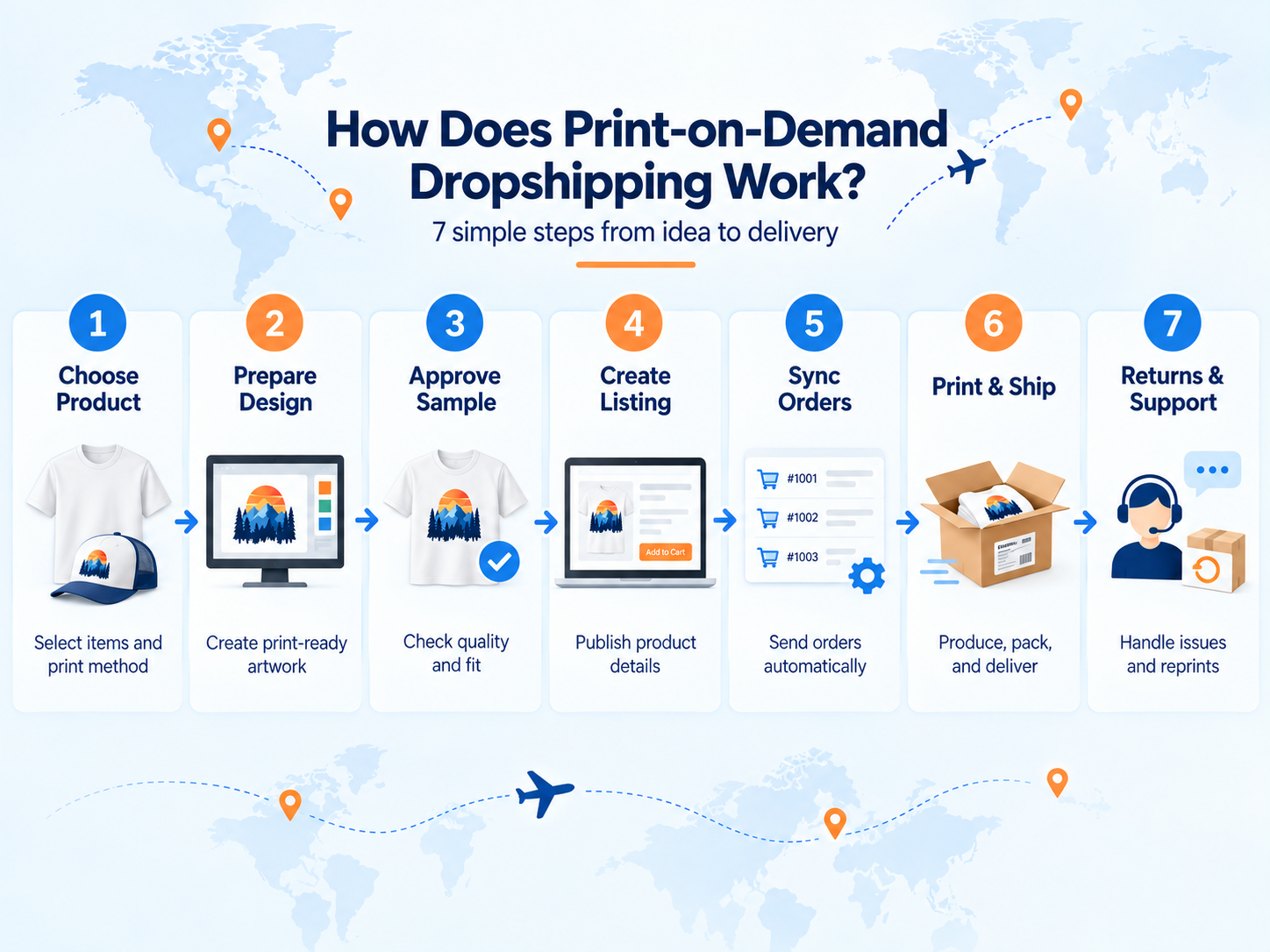
Start with the product rather than the printing technology. Consider the target customer, intended use, expected selling price, design area, material, size range, and shipping requirements.
Personalization can be useful when the product concept depends on a specific audience or design identity. At the same time, customization should solve a clear customer need rather than being added simply because a supplier offers the option.
A T-shirt may be suitable for DTG or DTF printing, while a cap may work better with embroidery. A mug, phone case, poster, or other hard-surface product may require sublimation, UV printing, or another process.
The design needs to match the production method and printable area. Confirm file resolution (standard 300 DPI), color profiles (CMYK vs. RGB), bleed lines, transparency layers, and design dimensions before production.
For branded products, sellers should also specify logo placement, label requirements, packaging instructions, inserts, and any other customer-facing details.
Samples are essential because a digital mockup cannot fully reflect physical print outcomes.
Test physical samples to verify color accuracy, print positioning, wash durability, material quality, garment sizing, packaging, and overall appearance. For products that will be sold repeatedly, sample approval should become part of the supplier-selection process rather than a one-time optional step.
Once the physical sample is approved, create product images and listings based on the actual product.
The listing should clearly explain product dimensions, materials, available variants, customization options, production expectations, and delivery estimates. Accurate product information reduces customer confusion and makes later returns easier to manage.
The ecommerce store should transmit product, variant, customer, and shipping information to the supplier after an order is placed.
Automation becomes increasingly important when a seller has multiple designs or sales channels. Correct SKU and variant mapping prevents problems such as incorrect sizes, colors, or designs being sent to production.
The supplier produces the customized item, performs the required quality checks, packs the order, and hands it to the selected carrier.
For international sellers, fulfillment location matters because shipping distance, customs procedures, carrier options, and destination-country delivery infrastructure can influence both cost and delivery time.
POD sellers need clear procedures for defective prints, damaged products, incorrect customization, lost packages, and customer returns.
Before launching, confirm who pays for reprints, how photographic evidence is handled, how claims are submitted, and whether returned products can be restocked or must be discarded.
| Stage | Seller/Brand Responsibility | Supplier Responsibility |
| Product Setup | Select product and create original design | Confirm file printability and technical feasibility |
| Sample | Review and approve | Produce and ship initial sample units |
| Listing | Write product copy and configure pricing and variants | Provide exact template dimensions and specs |
| Order | Receive customer orders and payments | Receive and process order data |
| Production | Monitor fulfillment exceptions | Print/customize and inspect |
| Fulfillment | Provide customer tracking and updates | Pack and ship orders |
| After-Sales | Handle customer inquiries | Process valid reprint claims for production errors |
Direct-to-Garment printing sprays ink directly onto fabric fibers, which makes it ideal for 100% cotton garments with detailed, multi-color artwork.
Direct-to-Film printing applies artwork onto a specialized transfer film before heat-pressing it onto the product, allowing it to work exceptionally well across cotton, polyester, nylon, and synthetic blends.
Sublimation printing uses heat to fuse dye directly into polyester fabrics or polymer-coated hard surfaces, making it popular for all-over print apparel, ceramic mugs, and aluminum art panels.
UV printing cures ink instantly using ultraviolet light, which makes it suitable for rigid items like phone cases, acrylic plaques, and wooden signs.
The important question is not which technology sounds more advanced, but whether the method produces the required appearance, durability, and cost at the intended production volume.
Embroidery stitches thread directly into caps, polo shirts, hoodies, and canvas bags to deliver a high-end, tactile finish.
Laser engraving etches precise designs onto wood, metal, leather, and acrylic products to create a permanent, premium look.
These methods can also involve setup charges or production limitations, so sellers should confirm pricing and minimum requirements before publishing customized products.
| Method | Best Product Substrates | Color & Detail Fidelity | Wash Durability | Setup & Pricing Consideration |
| DTG | 100% Cotton, ring-spun tees, hoodies | High (Photo-realistic gradients) | Good (Follow wash guides) | Depends on garment |
| DTF | Cotton, polyester, nylon, canvas, denim, and even leather | High (Vibrant solid colors) | High (Resistant to cracking) | Transfer production |
| Sublimation | 100% Polyester, polymer-coated mugs | High (Full-bleed coverage) | Good on suitable substrats (Fades-proof) | Requires compatible material |
| UV Printing | Phone cases, acrylic, wood, tumbler cups | High (Dimensional textures) | High (Scratch-resistant) | Surface compatibility |
| Embroidery | Caps, beanies, apparel, bags | Moderate to high (Vector/logo art) | Superior (Longest lasting) | Stitch count/setup |
| Laser Engraving | Wooden boards, metal, leather, acrylic | High for line/detail work | Permanent (Indestructible) | Material and machine setup |
Apparel remains a major POD category because sellers can combine common products with niche artwork, brand graphics, typography, or community-focused designs.
However, product quality depends on more than the print. Fabric composition, garment weight, sizing consistency, shrinkage, stitching, and color availability can all affect customer satisfaction.
Accessories offer another route for print-on-demand dropshipping, especially when the design is highly visual.
Tote bags may support DTF or other decoration methods. Caps may require embroidery depending on the design. Phone cases and similar accessories can use printing technologies designed for hard surfaces.
Home and lifestyle products can support a broader range of artwork and personalization. Mugs, wall art, cushions, and similar products may also work well for seasonal or gift-oriented collections.
Product dimensions and packaging are particularly important because fragile or oversized products can significantly change fulfillment and shipping costs.
The best combination starts with the physical product and customer expectation. A detailed full-color illustration may require a different process from a simple one-color logo. A premium branded item may justify embroidery or engraving, while a low-price test product may need a simpler decoration method.
Before scaling, compare the actual sample, production cost, expected selling price, shipping cost, and customer perception together.
The base product is the starting point for POD cost. A basic T-shirt, mug, tote bag, or phone case may have a different cost structure from a premium garment or specialized accessory.
Material quality should therefore be considered alongside the base price. A cheaper blank product may generate more returns or weaker customer reviews if the quality does not match the listing.
Customization cost depends on the production method, print area, number of colors, design complexity, stitch count, material, and order quantity.
Ask suppliers whether customization is included in the quoted unit price or charged separately.
Some projects require design preparation, artwork adjustment, mockups, samples, or production proofs. These costs may be small for a simple product but become more important when launching multiple SKUs.
For serious brands, sample approval is usually worth including in the initial budget because it reduces the risk of scaling an unverified design.
Packaging can include standard mailers, boxes, inserts, branded materials, labels, and kitting.
Platform or app fees may also apply depending on how orders are connected to the supplier. Sellers should calculate these costs per delivered order rather than looking only at the product price.
Shipping is often one of the largest variable costs. Destination, package dimensions, weight, shipping method, customs, taxes, and fuel-related charges can all affect the final cost.
Reprints and reshipments should also be included in the financial model because even a small defect or delivery problem can reduce the contribution margin of a POD order.
A practical calculation is:
Total delivered order cost = Base Product + Customization + Setup/Proofing + Packaging + Platform Fees + Fulfillment + Shipping + Taxes/Duties + Expected Reprint/Return Cost
The purpose of this calculation is not to create a universal POD price. It is to make supplier quotes comparable.
Selling price should account for the full delivered cost rather than simply applying a markup to the blank product.
For example, a product with a low base price can still become expensive after customization, packaging, international shipping, platform fees, and expected after-sales costs are included.
Two suppliers may quote similar product prices but produce very different total costs after printing, packaging, fulfillment, and shipping are included.
A better comparison is the total cost per delivered order for the same product, destination, customization method, and service requirements.
Check product specifications, materials, weight (GSM), color availability, size ranges, and consistency between production batches.
Ask which methods are available for each product and request samples for important designs. Confirm printable areas and expected durability rather than relying only on supplier descriptions.
A reliable print-on-demand supplier should provide a simple, fast process for ordering and approving physical samples before launching full store collections.
POD may support low or single-unit order quantities, but custom packaging, labels, embroidery, special materials, or bulk manufacturing may introduce separate minimums.
Evaluate normal turnaround times alongside holiday peak-season performance history. A supplier that performs well at 20 orders per day may need a different production plan when demand reaches several hundred orders.
Ensure full compatibility with your store for seamless SKU mapping, automated tracking number updates, and order exception handling. For Shopify merchants, choosing an experienced simplifies your entire order routing workflow.
If the goal is to build a recognizable brand, confirm whether the supplier offers custom poly mailers, branded stickers, inner neck labels, and promotional inserts to elevate your unboxing experience.
Compare delivery networks, destination coverage, and customs clearance procedures. According to , fast, transparent shipping and reliable fulfillment are major drivers of repeat purchases and long-term customer loyalty.
Review supplier policies regarding production misprints, damaged goods, transit losses, and customer returns. Clarify who covers replacement costs and what documentation is required.
Design ownership and file security should be addressed before sharing commercial artwork. Sellers should also confirm restrictions on copyrighted characters, trademarks, logos, and other protected content.
Operational problems need fast communication. Test customer support response times to ensure urgent order changes, shipping delays, or defect claims are handled quickly.
Use this scorecard to evaluate and compare prospective manufacturing partners:
| Evaluation Criteria | Key Review Focus | Target Benchmark |
| Print Quality & Durability | Color accuracy, crispness, and wash resistance | Zero fading or peeling after 10+ standard wash cycles |
| Production Speed | Processing time from order placement to shipping | 24 to 48 hours for standard print orders |
| Delivery Reliability | On-time delivery rate across target destination countries | 95%+ on-time delivery rate |
| Defect Rate | Percentage of misprints, defects, or damaged shipments | Under 2.5% total order defect rate |
| Integration & Automation | Seamless automated order routing and tracking sync | 100% automated SKU mapping and status updates |
| Brand Customization | Availability of neck labels, mailers, and inserts | Full custom packaging options available |
AK Dropshipping can support sellers at the sourcing stage by helping evaluate product availability, customization requirements, and supplier feasibility before a product is added to the store.
This is particularly useful when a seller has a design concept but needs to determine which base product and production process can support it.
Samples provide a physical reference for production quality. Quality inspection can help verify product specifications, customization, packaging, and order accuracy before a product is scaled.
For sellers moving beyond generic POD products, customization can extend to logos, labels, packaging, inserts, and product bundles.
This creates a possible transition from testing individual designs to developing a more consistent branded product experience.
Not every product needs to remain purely made-to-order. Once a product demonstrates consistent demand, sellers can consider pre-stocking selected products or components.
This hybrid approach can help balance customization flexibility with faster fulfillment for proven SKUs.
After orders are received, fulfillment involves more than simply shipping the product. Order synchronization, tracking updates, packaging, carrier selection, and exception handling all affect the customer experience.
A practical growth path can start with small-scale POD testing, move successful products into repeat production, and eventually introduce pre-stocked inventory, custom packaging, or larger private-label orders. This approach allows sellers to validate demand before committing more capital to inventory and branding.
Print-on-demand dropshipping can reduce the upfront inventory commitment involved in launching customized ecommerce products, but the model still requires careful control of product quality, customization costs, fulfillment, shipping, and after-sales operations. The most suitable supplier is not necessarily the one offering the lowest base product price. Sellers should compare the complete delivered-order cost, production reliability, integration capabilities, branding options, and support process. For new products, sampling and small-scale testing can reduce risk. For proven products, a hybrid model that combines POD testing with warehousing and branded fulfillment can provide a more practical path toward higher order volumes and a stronger customer experience.
Print-on-demand dropshipping is a fulfillment model in which a supplier produces or customizes a product after a customer places an order. The seller manages the storefront, design, pricing, marketing, and customer relationship, while the supplier handles production and fulfillment.
Print-on-demand is a type of dropshipping, but the product is customized or produced after the order. Traditional dropshipping usually involves an existing product that is already available from supplier inventory.
Costs vary by product, customization method, supplier, packaging, shipping destination, platform, and after-sales requirements. Sellers should calculate the total cost per delivered order instead of comparing only the base product price.
It can be profitable when product demand, pricing, customization costs, shipping, marketing expenses, and return rates support a healthy contribution margin. Profitability is not guaranteed, so product and supplier testing are important before scaling.
Many POD suppliers can fulfill individual orders, but custom packaging, labels, embroidery, special materials, or bulk production may have separate minimum quantities or setup fees. Confirm these requirements for each part of the order.
Evaluate product quality, customization methods, sample approval, production time, pricing, integrations, packaging, shipping coverage, tracking, intellectual-property policies, reprint rules, returns, and customer support. A small initial test can help verify the supplier before larger order volumes are introduced.