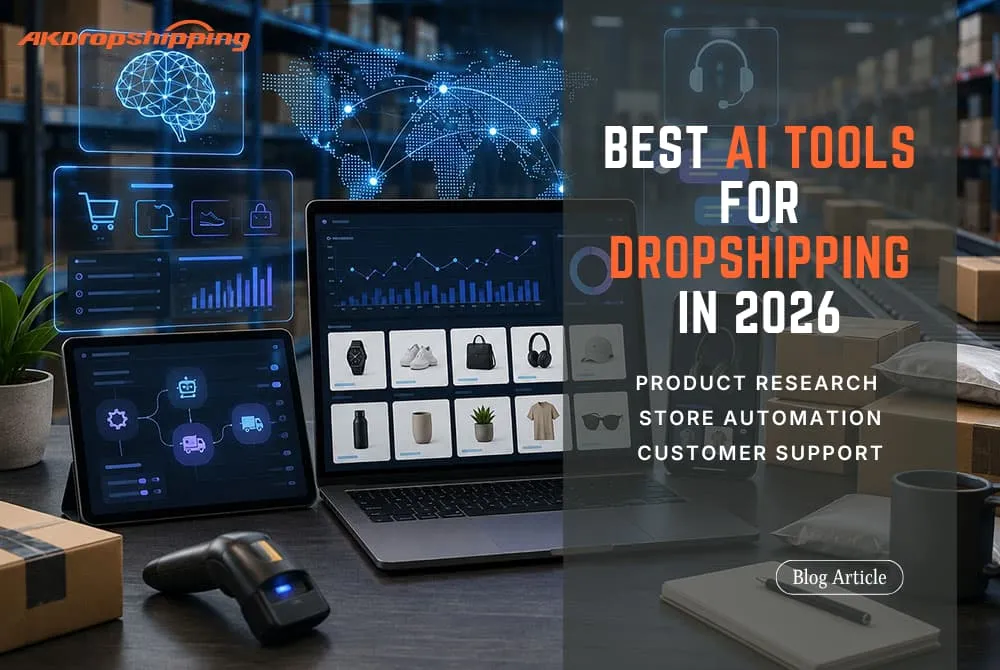
AI tools are transforming how dropshipping sellers find products, build stores, write listings, manage campaigns, and handle customer support. In 2026, successful dropshipping is no longer about uploading as many random products as possible. It's about using data, automation, and reliable fulfillment to build a faster, leaner, and more customer-focused ecommerce operation.
That said, AI tools can't replace the entire dropshipping supply chain. They can help sellers discover product ideas, generate descriptions, build email flows, automate replies, and organize operations. But product sourcing, supplier negotiation, quality inspection, inventory prep, packing, shipping, and after-sales support still require a reliable fulfillment partner.
AK Dropshipping helps sellers bridge the gap between AI-driven ecommerce and real-world execution. Sellers can use AI to research products and generate orders, then rely on AK Dropshipping for sourcing, quality inspection, free warehousing, automated fulfillment, global shipping, and private label support.
AI is transforming dropshipping because it helps sellers process product data, market signals, customer questions and store tasks faster than ever. Instead of spending hours checking competitors, writing copy or replying to repetitive questions, sellers can use AI to streamline routine workflows and focus on strategy.
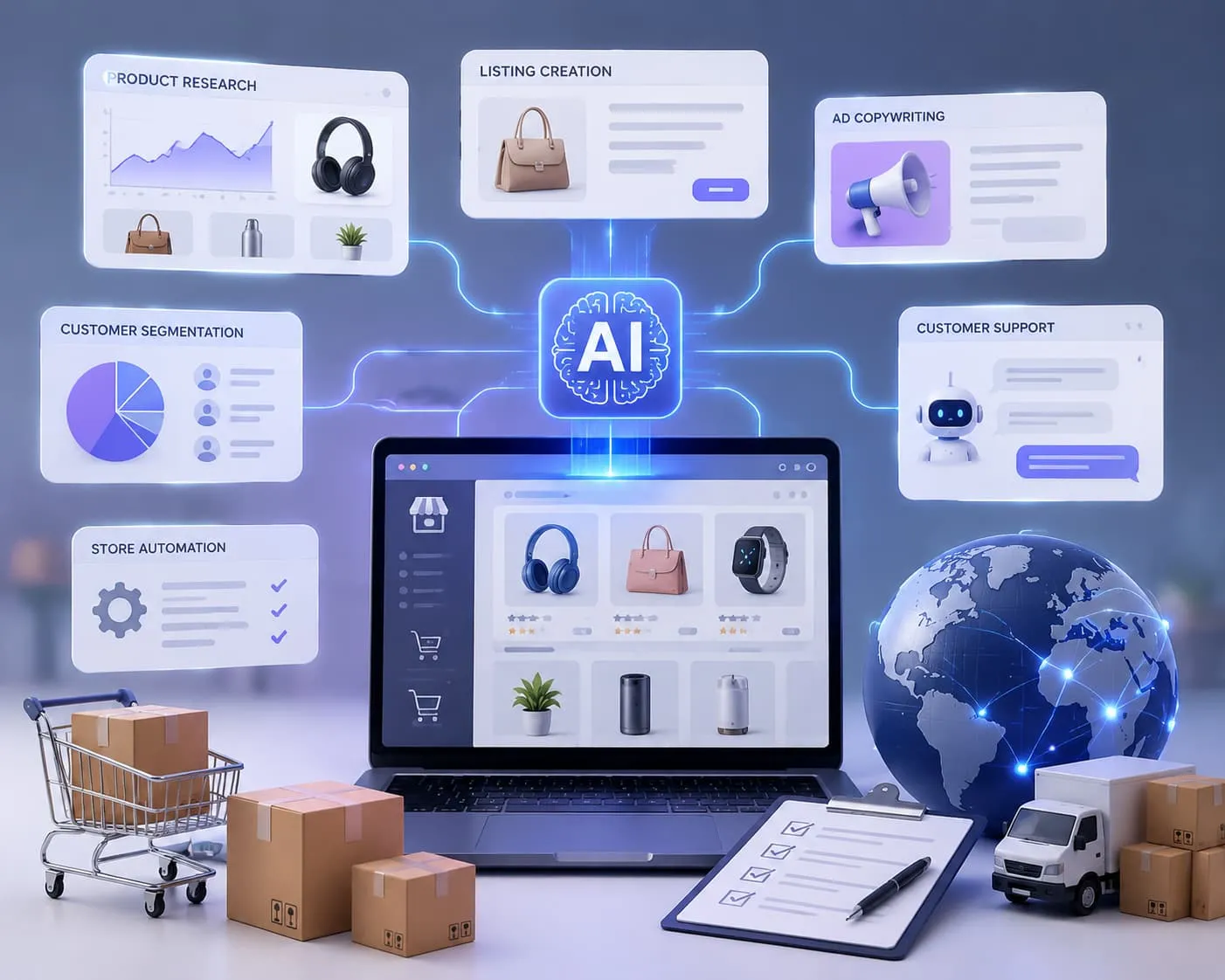
AI tackles many repetitive, data-heavy tasks in dropshipping, including product research, listing creation, ad copywriting, customer segmentation, and basic support.
The biggest challenge for new sellers is usually product selection. AI product research tools can scan trending items, supplier catalogs, competitor stores, ad creatives and marketplace signals faster than a human. Tools such as Sell The Trend, AutoDS Product Finding Hub and Niche Scraper help sellers identify products that already show demand, rather than guessing blindly.
The second challenge is store setup. Many beginners struggle with product pages, product descriptions, image design, basic Shopify setup and automation rules. AI tools such as AutoDS AI Store Builder, Shopify Magic and Shopify Sidekick can cut down the time it takes to launch a store or improve existing pages.
The third challenge is customer communication. AI support tools can answer common questions about shipping, returns, product details and order status. This is especially important when stores receive more traffic from paid ads or seasonal campaigns.
AI still can't fully replace supplier relationships, product quality control, logistics execution, brand judgment, or customer trust management. It can recommend products, but it can't physically inspect them before shipment. It can write a return policy, but it can't resolve a lost package without a fulfillment process.
For example, an AI tool might suggest a trending pet product, but the seller still needs to confirm actual product quality, supplier capacity, packaging, shipping cost, delivery time, and return risk. This is where a fulfillment partner becomes essential.
The best AI tools for dropshipping should be chosen based on the task, not just popularity. Most sellers need different tools for product research, store automation, content creation, email marketing, and customer support.
AI product research tools help dropshipping sellers discover, validate, and compare product opportunities before launching. The best tools in this category help answer whether a product has demand, whether it's already saturated, whether ads are working, and whether suppliers are available.
Sell The Trend (NEXUS AI) is a dropshipping product research tool designed to help sellers find winning products, analyze demand, and review competitor signals.
Best for: Sellers who want a product research tool with broader dropshipping workflow support.
Key features: Product discovery, ad research, competitor insight, Shopify integration, one-click product import, supplier access.
Pros: Strong product and competitor research, all-in-one platform, fast product import.
Cons: Beginners still need to verify product quality, supplier reliability, and shipping cost before scaling.
Sell The Trend is useful when sellers want to move quickly from product idea to product listing. However, the output shouldn't be treated as final proof. Sellers should still request supplier confirmation and check fulfillment feasibility before launching aggressive ads.
AutoDS Product Finding Hub is an AI-assisted product research feature that helps sellers discover trending products, hand-picked products, ads, and TikTok-related product signals.
Best for: Sellers already using AutoDS or those who want research plus automation in one ecosystem.
Key features: Trending product discovery, TikTok signals, automation integration, supplier marketplace browsing.
Pros: Connects research with automation, good for testing multiple ideas quickly.
Cons: Some advanced features may require add-ons or higher plans.
AutoDS Product Finding Hub can reduce manual product hunting, especially for sellers who want to test multiple ideas quickly. It works best when paired with a clear product validation process.
Niche Scraper is a product research and competitor analysis tool that helps sellers identify winning products, Shopify store trends, and ad ideas.
Best for: Beginners and smaller sellers who want a direct product research tool without a heavy automation stack.
Key features: Product discovery, competitor store analysis, ad inspiration, simple interface.
Pros: Easy to use, good for idea generation, useful testing inspiration.
Cons: Research results may be seen by many users, so product saturation and supplier confirmation must still be checked.
Niche Scraper is best used as an idea-generation tool. After finding a product, sellers should still calculate product cost, shipping cost, expected margin, and fulfillment risk.
AI store building and automation tools help sellers create store pages, generate content, import products, sync orders and reduce manual setup work. These tools help create conversion-ready Shopify stores quickly.
AutoDS AI Store Builder helps sellers build a Shopify dropshipping store faster by generating product pages, importing winning products, and connecting store automation workflows.
Best for: Beginners who want to launch quickly without designing every page manually. Also useful for testing stores around specific niches.
Key features: AI-generated product pages, winning product import, store automation workflows.
Pros: Fast store setup, reduced manual work, good for testing niches.
Cons: AI-built stores still need human editing for positioning, trust elements, brand tone, and conversion optimization.
Shopify Magic is Shopify's built-in AI feature set for merchants, helping with tasks such as product descriptions, content generation, and store productivity.
Best for: Shopify merchants who want AI support without adding many extra apps.
Key features: Product description generation, content creation, tone adjustment, native Shopify integration.
Pros: No extra apps needed, works directly in Shopify, useful for basic content.
Cons: Limited outside Shopify ecosystem, works best with accurate product details.
Shopify Sidekick is Shopify's AI commerce assistant designed to help merchants understand store data, complete tasks, and make decisions within Shopify.
Best for: Merchants who want help interpreting store performance, improving product pages, or navigating Shopify workflows.
Key features: Store data interpretation, task assistance, workflow navigation, Shopify context awareness.
Pros: Uses Shopify context, helps with store analysis and admin tasks.
Cons: Still needs human judgment; AI suggestions may not fully understand supply chain limits or actual product quality.
AI content tools help dropshipping sellers create product descriptions, ad copy, social media content, banners, emails, FAQs, and brand assets more efficiently. This category is important because product pages and creatives often determine whether visitors trust the store.
Canva is a visual design platform that helps sellers create product banners, social posts, ads, packaging mockups, and brand assets.
Best for: Sellers who need quick product visuals, social media creatives, and store graphics without hiring a designer for every asset.
Key features: Template library, drag-and-drop editor, brand kit, social media templates, packaging mockups.
Pros: Easy to use, large template library, no design skills needed.
Cons: Templates can look generic if sellers don't customize colors, fonts, and layout.
ChatGPT is a general-purpose AI writing and reasoning tool that can help dropshipping sellers write product descriptions, FAQs, ad angles, email drafts, customer service scripts, and product research prompts.
Best for: Flexible content work. It can generate product titles, SEO descriptions, comparison tables, and support scripts.
Key features: Long-form writing, brainstorming, code generation, multi-language support, conversation-based interface.
Pros: Versatile writing and reasoning, fast content generation, good for multiple use cases.
Cons: Sellers must provide accurate product specs and review output carefully to avoid exaggerated claims.
Claude is an AI assistant often used for long-form writing, summarization, research review, and structured content creation.
Best for: Longer product pages, policy drafts, customer education content, and brand storytelling.
Key features: Long-form writing, summarization, structured content, careful rewriting, research review.
Pros: Strong long-form structure, careful rewriting, good for detailed content.
Cons: Output still needs verification; sellers must fact-check product claims.
Jasper AI is a marketing-focused AI content platform built for brand and campaign content production.
Best for: Sellers building a content workflow across multiple brands, campaigns, or team members.
Key features: Brand voice customization, campaign workflows, team collaboration, marketing templates.
Pros: Brand voice and marketing workflows, consistent content across teams.
Cons: Higher cost for beginners; may be overkill for small stores.
AI email marketing tools help sellers segment customers, build automated flows, personalize offers, and recover more revenue from existing traffic. For dropshipping stores, email is important because paid ad costs can be high and repeat customer value matters.
Klaviyo AI is a marketing automation and customer data platform for ecommerce brands, supporting email, SMS, segmentation, and customer lifecycle campaigns.
Best for: Stores with enough traffic and customer data to support segmentation.
Key features: AI email flows, customer segmentation, lifecycle campaigns, SMS marketing, behavioral triggers.
Pros: Strong ecommerce lifecycle marketing, AI-powered flows and segmentation.
Cons: Needs enough data to be effective; may be complex for beginners.
Typical flows include welcome series, abandoned cart recovery, post-purchase education, win-back campaigns, product recommendations, and holiday promotions. Beginners can start with basic flows, while growing stores can use advanced segmentation based on behavior, purchase history, and customer lifecycle stage.
AI customer support tools help dropshipping stores answer repetitive questions, reduce support workload, and improve response speed. This matters because customers often ask about shipping time, tracking updates, returns, product sizing, and order changes.
Tidio Lyro is an AI customer support agent that can answer common customer questions using store knowledge, FAQ content, and support resources.
Best for: Small to mid-sized stores that want live chat and AI answers in one tool.
Key features: AI chatbot, live chat integration, FAQ automation, store knowledge base.
Pros: Easy customer support automation, live chat integration, reduces repetitive questions.
Cons: Complex issues need humans; may not handle nuanced questions well.
Gorgias AI Agent is an ecommerce customer support AI agent designed for Shopify brands and customer experience teams.
Best for: Growing stores with larger support volumes and more structured support workflows.
Key features: AI support automation, order questions handling, FAQ management, policy answers, CX workflows.
Pros: Strong CX automation, handles order questions and FAQs well.
Cons: Cost must be monitored; sellers should track resolved interactions and monthly support volume.
A comparison of popular AI dropshipping tools helps sellers understand which tools fit product research, store building, content creation, email marketing, and customer support. No single AI tool covers every part of dropshipping, so sellers should build a tool stack based on their business stage.
Tool | Main Use | Best For | Pricing Reference | Key Strength | Main Limitation |
Product research, trend discovery, store intelligence | Product hunters and scaling sellers | Paid plans | Strong product and competitor research | Needs supplier and shipping verification | |
Product research and automation add-on | Sellers using AutoDS ecosystem | Trial and paid plans | Research connects with automation | Some features may require add-ons | |
Product and competitor research | Beginners and lean stores | Paid plans | Simple product discovery | Potential saturation risk | |
Store building and import automation | Beginners launching fast | AutoDS plan-based | Fast Shopify store setup | Needs brand editing | |
Shopify built-in AI content tools | Shopify merchants | Shopify ecosystem | Native Shopify workflow | Limited outside Shopify | |
Shopify AI assistant | Store analysis and admin help | Shopify availability varies | Uses Shopify context | Still needs human judgment | |
Visual design and creatives | Ads, banners, social content | Free and paid plans | Easy creative production | Template sameness risk | |
Writing, research, support scripts | Flexible content and strategy work | Free and paid plans | Versatile writing and reasoning | Needs fact-checking | |
Long-form writing and structured drafts | Detailed content and policies | Free and paid plans | Strong long-form structure | Output still needs verification | |
Marketing content workflows | Teams and branded campaigns | Paid plans | Brand voice and marketing workflows | Higher cost for beginners | |
Email flows and segmentation | Stores with customer data | Usage-based / plan-based | Strong ecommerce lifecycle marketing | Needs enough data | |
AI chat and live chat | Small to mid-sized support teams | Free and paid plans | Easy customer support automation | Complex issues need humans | |
Ecommerce support automation | Growing Shopify stores | Usage / plan-based | Strong CX automation | Cost must be monitored |
Tips: Start with tools that solve your biggest bottleneck. Adding more software doesn't always improve productivity—it often increases costs and complexity.
When you're just getting started, your priorities are validating products, launching a professional-looking store, and keeping costs under control.
A simple setup might look like this:
Task | Recommended Tool |
Product Research | Sell The Trend or Niche Scraper |
Store Setup | AutoDS AI Store Builder or Shopify Magic |
Product Descriptions | ChatGPT |
Product Images & Social Posts | Canva |
Customer Support | Tidio Lyro |
Fulfillment | AK Dropshipping |
At this stage, avoid subscribing to too many premium AI tools. Focus on validating products first, then invest in additional automation as your business grows.
Once your store has consistent sales, efficiency becomes more important than simply launching products.
Growing stores often benefit from a combination like this:
Task | Recommended Tool |
Product Research | Sell The Trend + AutoDS |
Store Management | Shopify Magic + Shopify Sidekick |
Content Marketing | ChatGPT or Jasper AI |
Creative Design | Canva |
Email Marketing | Klaviyo AI |
Customer Support | Gorgias AI Agent |
Fulfillment | AK Dropshipping |
At this stage, automation helps reduce manual work while improving customer experience across marketing, operations, and support.
Combining AI with reliable fulfillment creates a stronger dropshipping workflow because AI can improve front-end speed while a fulfillment partner handles the operational backend. This combination is often more effective than using AI tools alone.
AI can identify trending products, but AK Dropshipping can help source, quote, and confirm those products. A practical workflow is simple: use AI tools to identify a product idea, check competitors and estimate demand, then submit the product to AK Dropshipping for sourcing confirmation, cost quote, and fulfillment feasibility.
AI tools can improve product pages, ads and emails, but fulfillment still needs order processing, packing, shipping and tracking. AK Dropshipping’s one-click dropshipping fulfillment guide explains how order sync, product sourcing, packaging, inventory support and tracking updates can connect into one automated fulfillment workflow.
AI can help create brand names, packaging concepts, product descriptions, email flows, and social media content. But private label execution still requires real manufacturing, packaging, sample confirmation, and fulfillment.
AK Dropshipping supports private label services such as custom logos, packaging, sample confirmation, production, and fulfillment. This helps sellers move from generic dropshipping to branded ecommerce without building their own sourcing office or warehouse.
Combining AI tools with AK Dropshipping works because AI improves speed while AK Dropshipping improves operational reliability. AI helps sellers discover and market products; AK Dropshipping helps sellers source, inspect, store, pack, and ship those products.
This combination reduces the gap between "AI found a product" and "the customer received a good product." For long-term dropshipping, that gap is where many stores fail. AK Dropshipping helps close it through sourcing, free warehousing, quality inspection, automated fulfillment, global shipping, and private label support.
AI is transforming dropshipping by making product research, store management, content creation, email marketing, and customer support faster and more efficient.
Tools like Sell The Trend, AutoDS, Shopify Magic, ChatGPT, Claude, Canva, Klaviyo, Tidio, and Gorgias each solve specific challenges within the ecommerce workflow.
However, AI cannot replace the physical supply chain. Product sourcing, quality inspection, inventory preparation, packaging, and global shipping still require experienced fulfillment partners.
By combining AI-powered automation with AK Dropshipping's sourcing, warehousing, fulfillment, and private label services, sellers can build a scalable business that delivers both operational efficiency and a better customer experience.
There isn't a single best AI tool for every seller. Sell The Trend, AutoDS, and Niche Scraper are excellent for product research, while ChatGPT and Claude help with content creation. Klaviyo is a leading choice for email marketing, and Tidio or Gorgias can automate customer support.
Yes. ChatGPT can generate SEO-friendly product descriptions, FAQs, blog posts, advertising copy, and email campaigns. Sellers should always review AI-generated content to ensure it accurately reflects the product and aligns with their brand voice.
AI tools such as AutoDS AI Store Builder, Shopify Magic, and Shopify Sidekick can significantly reduce the time needed to launch and manage a Shopify store. However, sellers should still customize branding, optimize product pages, and verify all product information before publishing.
AI chatbots can answer many routine questions about shipping, returns, and order tracking. However, complex issues involving refunds, complaints, or damaged products are still best handled by human support teams.
No. AI can automate many digital tasks, but product sourcing, supplier communication, quality inspection, packaging, fulfillment, and logistics still require operational support and human decision-making.
AI helps sellers find products, create content, and automate workflows, while a fulfillment partner manages the physical supply chain. Combining both creates a more reliable and scalable dropshipping business.