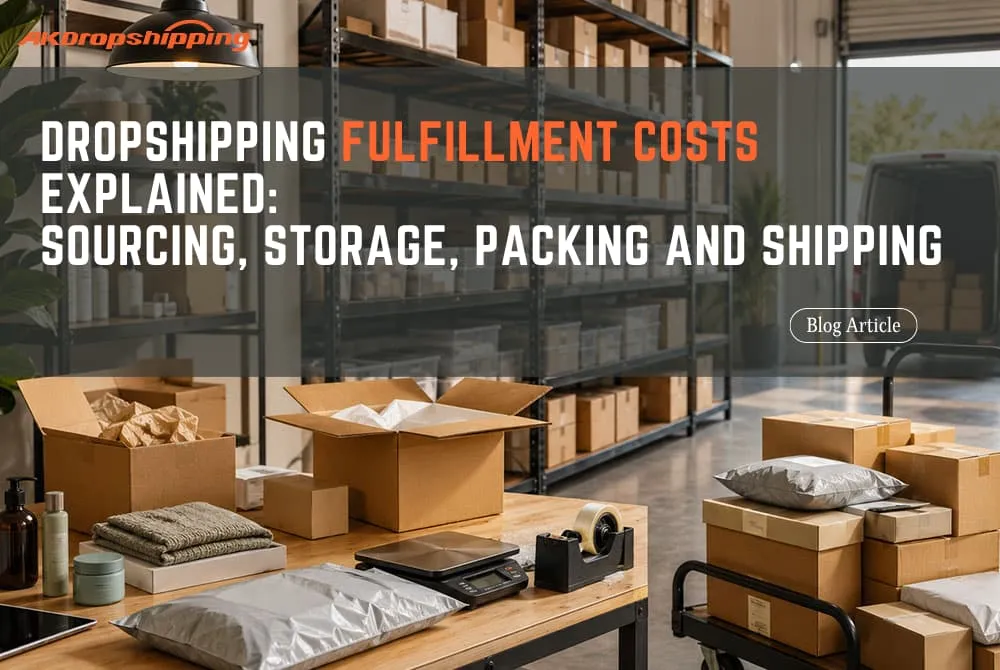
Dropshipping fulfillment costs are one of the most important factors that determine whether an ecommerce store is truly profitable. Many sellers focus only on product price and selling price, but the real cost of an order also includes sourcing, storage, picking, packing, quality inspection, international shipping, taxes, customs, failed delivery and possible reshipments.
In modern dropshipping, sellers often use third-party fulfillment services instead of handling inventory and shipping directly. Shopify explains that when merchants use a dropshipping or fulfillment service, they usually work with the service provider to determine shipping and fulfillment costs rather than working directly with carriers. This makes cost transparency especially important before scaling ads or launching a new product.
AK Dropshipping helps ecommerce sellers manage product sourcing, procurement, free warehousing, quality inspection, packing, shipping, tracking sync and private label support through one fulfillment workflow. For sellers who want to protect profit margins, understanding every cost component before scaling is the first step.
Dropshipping fulfillment costs are all expenses involved in delivering a product from the supplier to the customer’s doorstep. While many sellers only focus on product price, fulfillment actually includes several operational costs that determine whether each order is profitable.
A typical dropshipping order includes the following cost categories:
Cost Layer | What It Means |
Product Cost | The base product price from supplier or manufacturer |
Sourcing Fee | Cost of finding, confirming or purchasing the product |
Warehousing | Inventory storage and stock management before fulfillment |
Order Processing | Cost of picking, packing and quality inspection |
Packaging | Standard, protective or custom packaging materials |
Shipping | International delivery to the customer |
Taxes & Customs | VAT, import duties, customs clearance, and destination-related charges |
Hidden Costs | Returns, reshipments, payment fees, currency conversion, and overstock |
For AK Dropshipping, the practical pricing logic can be summarized as:
Total Cost = Product Cost + Labor / Packing Service Cost + Custom Packaging Cost + Shipping Cost + Tax Fees + Payment Conversion
This structure helps sellers understand what they are paying for and avoid judging a fulfillment quote only by the product price.
Fulfillment costs matter because they directly affect gross margin, advertising budget, pricing strategy and customer satisfaction. A product can look profitable at first glance but become unprofitable after shipping, packaging, returns and payment fees are included.
For example, a product sourced for $8.00 and sold for $34.99 suggests a strong initial margin. However, adding international shipping ($5.80), packaging and handling ($2.20), plus taxes and hidden fees ($2.40) drives the true landed cost to $18.40. This leaves a gross margin of only $16.59. After spending $10 on ads to acquire a customer, the final net profit shrinks to just $6.59.
This is why sellers should calculate total fulfillment cost per order before testing paid traffic. A low product price is not enough; the final landed cost must support healthy margins.
Understanding where your money goes helps you identify opportunities to improve margins and compare fulfillment partners more effectively.
Product sourcing is the foundation of every fulfillment order because it determines your starting profit margin.It may include the following elements.
Base Product Price: The direct manufacturing or factory floor cost per unit. Explore curated catalog items on AK Dropshipping Winning Products to evaluate high-margin SKUs before launching campaigns.
Minimum Order Quantity (MOQ): Traditional supply chains require bulk upfront commitments. Modern fulfillment partners offer a No MOQ policy, enabling single-unit order execution for product testing without capital risk.
Sample Procurement: Verification costs for checking product quality, material integrity, and functionality prior to scaling.
Sourcing Service Fees: Compensation for supplier verification and price negotiation. Sourcing platforms typically return quotation terms within 24 hours to streamline validation.
Warehousing becomes increasingly important as stores begin scaling beyond one-off orders. Rather than purchasing products only after each sale, many successful sellers pre-stock inventory to shorten processing times and improve delivery consistency.
Storage Fees: Conventional 3PLs often charge monthly fees based on bin volume, pallet space, or SKU count.
Free Warehousing Models: AK Dropshipping provides free warehouse storage with no time limits across its 3,500m² facilities in Hangzhou and Shenzhen, eliminating monthly holding overhead for pre-stocked inventory.
Receiving & Inbound Processing: Stock ingestion protocols, inventory registration, and SKU barcode mapping to ensure accurate system synchronization.
Order processing costs include picking, packing and quality inspection. These costs are often small per order but become significant when order volume increases.
Picking Labor: Locating the exact SKU, size, and color variant in the warehouse.
Quality Control (QC): Physical pre-shipment inspections (verifying dimensions, functionality, and cosmetic defects) to reduce return rates.
Order Preparation: Items are inspected, repackaged, and routed for dispatch within 24 hours for pre-stocked inventory.
Packing costs include standard packaging, protective packaging, custom packaging and private label packaging. This cost category affects both shipping safety and brand perception.
Standard Packaging: Basic poly mailers or corrugated boxes suitable for non-fragile items.
Protective Packaging: Air columns, bubble wrap, corner guards, and reinforced outer cartons for fragile, cosmetic, or electronic goods.
Private Label Packaging: Custom logo mailers, branded boxes, product tags, and inserts (thank-you cards, manual guides, discount coupons). You can upgrade generic items into custom-branded assets via AK Private Label Dropshipping Services. Once designed, custom inserts carry minimal incremental application costs across bulk order batches.
International shipping costs are usually the largest and most variable part of dropshipping fulfillment. They depend on weight, dimensions, shipping zones and shipping methods.
l Actual Weight vs. Dimensional (Volumetric) Weight: Freight carriers bill packages based on total weight or total spatial volume, whichever value is higher. Refer to official FedEx Dimensional Weight Rules for exact volumetric calculation standards:
Common options of shipping include:
Shipping Method | Best For |
Economy Shipping | Low-cost products with flexible delivery times |
Standard Shipping | A balance of speed and affordability |
Express Shipping | High-value or time-sensitive orders |
Special Line Logistics | Popular ecommerce destinations with stable tracking |
Destination Zones: Regional pricing varies based on local postal infrastructure, remote area surcharges, and direct airline route availability.
AK Dropshipping works with multiple international logistics providers, allowing sellers to compare shipping routes based on destination, budget, and delivery requirements.
Taxes, customs and other fees are destination-related costs that may appear after the product enters the buyer’s country or region.
Import VAT / GST: Regional tax structures such as EU IOSS (Import One Stop Shop) regulations or UK VAT requiring prepaid tax clearance to streamline postal entry.
Customs Brokerage Fees: Administrative processing fees levied when clearing high-value goods through international border control.
Remote Area Surcharge: It may apply when a delivery address is outside normal service coverage.
These fees can reduce margins, especially for low-priced products or free-shipping offers.
Hidden fulfillment costs are expenses that are not always obvious in the first quote but can reduce profit after orders start scaling.
Incorrect addresses and customer refusals lead to costly returns and reshipments. Protect your margins by ensuring precise address verification, providing reliable tracking updates, and factoring a small reshipment buffer into your overall product pricing strategy.
Merchant processors charge foreign exchange spreads when converting international sales back to settlement accounts—review standard PayPal Currency & Cross-Border Fees to account for these margin adjustments.
Overstocking ties up capital and forces heavy discounting to clear inventory. Protect cash flow by relying on tested demand data—stock proven bestsellers to maintain fast delivery speeds while keeping unproven product quantities strictly minimal.
One of the biggest mistakes new sellers make is calculating only product cost and shipping.
A more accurate approach is to calculate the total fulfillment cost per order, which includes every expense required to deliver the product successfully.
Thinking in terms of total landed cost helps sellers price products more accurately and avoid shrinking profit margins as sales grow.
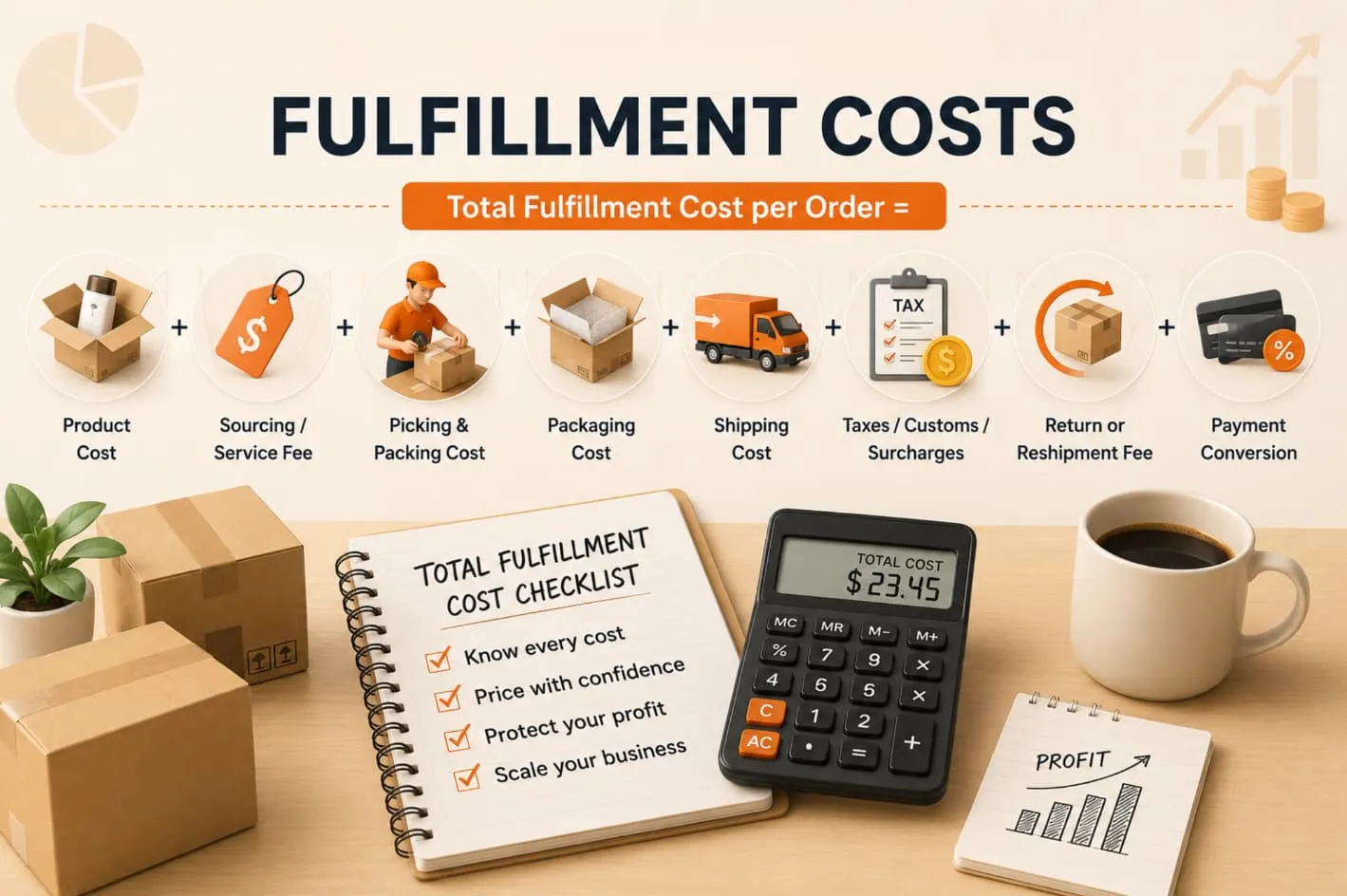
A practical formula for dropshipping sellers is:
Total Fulfillment Cost per Order = Product Cost + Sourcing / Service Fee + Picking & Packing Cost + Packaging Cost + Shipping Cost + Taxes / Customs / Surcharges + (Return or Reshipment Fee) + Payment Conversion
This is easier for sellers to explain internally because it separates the core cost layers: product, service, packaging, logistics and taxes.
Here is an example for a lightweight ecommerce product:
Cost Item | Example Cost |
Product price | $8.00 |
Sourcing / service fee | $0.80 |
Picking and packing | $0.60 |
Standard packaging | $0.30 |
Protective packaging | $0.50 |
International shipping | $5.80 |
Tax / customs / surcharge | $0.70 |
Payment conversion | $0.90 |
Return / reshipment risk | $0.80 |
Total fulfillment cost per order | $18.40 |
If the selling price is $34.99, the margin before ad spend and platform fees is:
$34.99 - $18.40 = $16.59
If the seller spends $10 to acquire a customer, the remaining profit before other business expenses is:
$16.59 - $10 = $6.59
This example shows why cost calculation must happen before scaling ads. A difference of $1–$2 in shipping or packaging can change the entire profit model.
Sellers should compare fulfillment quotations by total landed cost, not by one line item. A supplier with a cheaper product price may have higher shipping. Another supplier may offer better packing but slower processing. The right quote should balance cost, speed, quality and reliability.
A good quotation comparison should include:
Comparison Item | Supplier A | Supplier B | Supplier C |
Product price | |||
MOQ | |||
Sample cost | |||
Quality inspection | |||
Packing cost | |||
Shipping method | |||
Delivery time | |||
Customs / tax handling | |||
Return / resend policy | |||
Total landed cost |
Looking at the entire fulfillment process helps you identify suppliers that provide better overall value rather than simply lower product prices.
Reducing fulfillment costs isn't about choosing the cheapest supplier.
Instead, it's about optimizing each stage of the fulfillment process while maintaining a positive customer experience.
Here are several proven strategies.
Buying through multiple intermediaries often increases product costs without improving quality.
Working with a sourcing partner that has access to manufacturers can help sellers:
Reduce supplier markups
Compare multiple factories
Negotiate better pricing
Maintain consistent product quality
For growing stores, even small savings on product costs can significantly improve overall margins.
Shipping companies frequently calculate charges using dimensional weight rather than actual weight.
A package that's unnecessarily large may cost considerably more to ship.
Review your packaging regularly to ensure it:
Protects the product
Uses the smallest practical box
Avoids unnecessary filler materials
Reduces dimensional weight whenever possible
Small packaging improvements can create meaningful shipping savings over thousands of orders.
Not every product requires express shipping.
For example:
Economy shipping works well for inexpensive products.
Standard shipping offers a good balance between cost and delivery speed.
Express shipping is often better suited to premium products or urgent orders.
Choosing the right logistics route for each product category helps maximize profitability while meeting customer expectations.
Once a product demonstrates stable sales, preparing inventory in advance can improve fulfillment performance.
Benefits include:
Faster order processing
More stable inventory levels
Lower stockout risk
Better preparation for seasonal demand
Avoid stocking large quantities of untested products.
Instead, use sales data to determine which products deserve inventory investment.
Skipping quality control may reduce fulfillment costs slightly—but it often increases refunds, disputes, and negative reviews.
A thorough quality inspection helps identify:
Manufacturing defects
Incorrect product variants
Damaged packaging
Missing accessories
Preventing one replacement shipment is often less expensive than handling a customer complaint after delivery.
Managing separate suppliers, warehouses, shipping companies, and packaging providers can increase both costs and operational complexity.
An integrated fulfillment partner combines these services into one streamlined workflow, helping sellers:
Reduce communication delays
Improve order accuracy
Simplify inventory management
Scale more efficiently
This becomes especially valuable during peak shopping seasons when fulfillment speed directly affects customer satisfaction.
AK Dropshipping helps sellers reduce fulfillment costs by combining transparent sourcing, free warehousing, inventory management, quality inspection, fast processing, flexible shipping and private label support into one workflow.
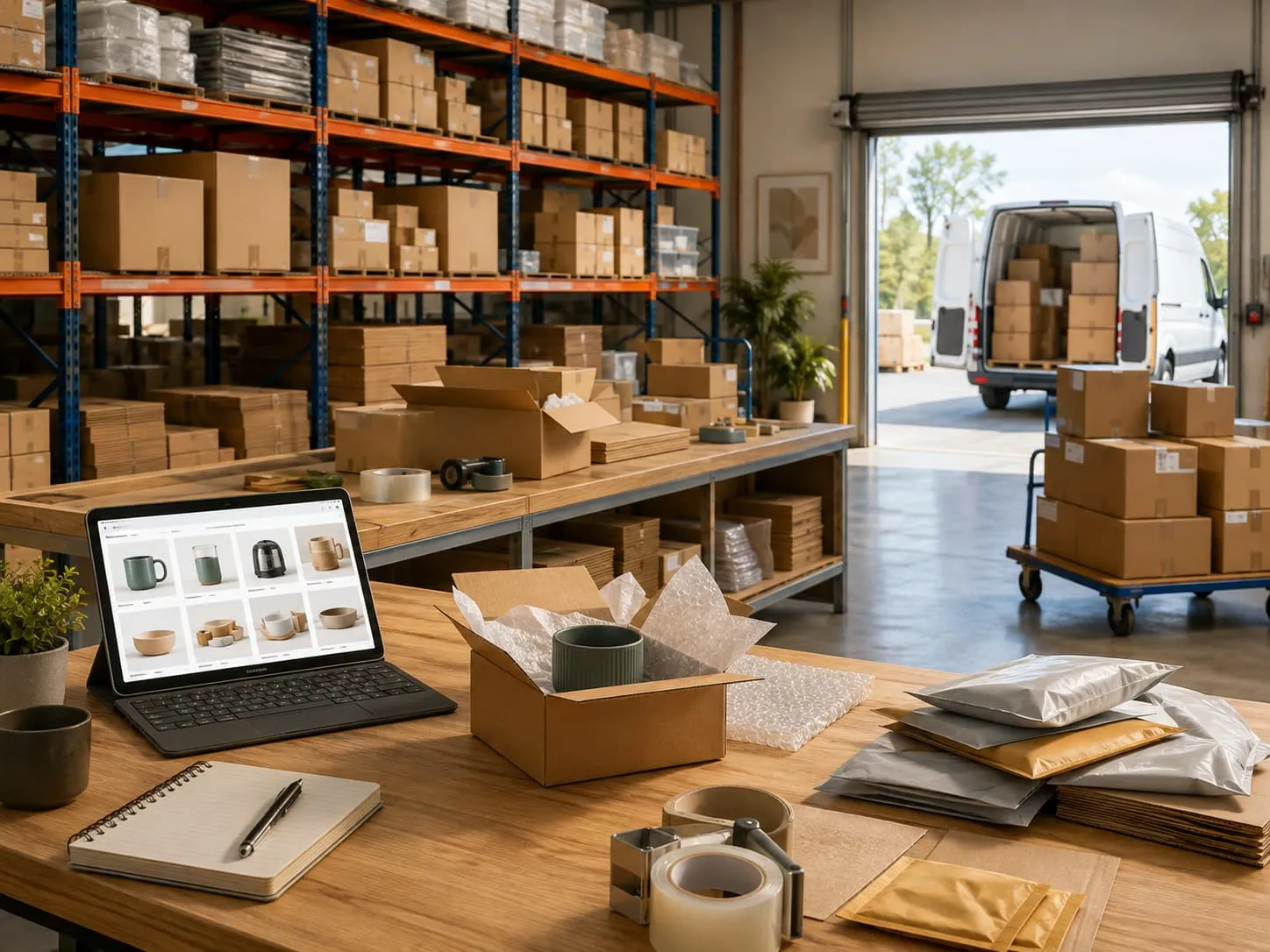
AK Dropshipping helps sellers source products directly from manufacturers, compare quotations, and prepare inventory with no minimum order quantity (MOQ).
Unlike many fulfillment providers, AK also offers free warehouse storage, allowing sellers to stock bestselling products without paying monthly storage fees. This is especially useful during peak shopping seasons when faster order processing is critical.
Quality inspection helps reduce defective shipments and improve customer satisfaction. Before orders leave the warehouse, AK Dropshipping checks product quality, verifies order details, and repackages items when needed to help minimize returns and fulfillment errors.
For faster order processing, sellers can prepare inventory in AK Dropshipping's Cloud Warehouse System. In-stock orders are typically processed within 24 hours, while products that require sourcing generally ship within 3–5 business days. To further improve efficiency, AK also supports one-click dropshipping fulfillment, which automates order synchronization, fulfillment processing, and tracking updates, helping sellers save time as their business grows.
AK Dropshipping works with multiple logistics partners, giving sellers the flexibility to choose shipping methods based on destination, delivery speed, and budget.
Rather than relying on a single carrier, sellers can compare shipping routes to balance cost, tracking reliability, and customer experience.
For sellers building their own brand, AK Dropshipping provides private label services including custom logos, branded packaging, insert cards, and product labels.
These branding options help create a more professional unboxing experience while allowing sellers to differentiate themselves in competitive markets.
Succeeding in cross-border e-commerce requires mastering the full unit economics of your business. Looking solely at base factory pricing or standard shipping fees creates blind spots that erode profit margins. True profitability depends on calculating your Total Landed Fulfillment Cost—factoring in sourcing fees, pick-and-pack labor, protective packaging, destination taxes, currency spreads, and potential reshipment allowances before scaling marketing budgets.
By evaluating fulfillment quotes on a total-landed-cost basis, optimizing package volume to avoid dimensional weight surcharges, and securing reliable quality inspection, brands can safeguard their cash flow against unexpected operational losses.
Partnering with an integrated logistics provider like AK Dropshipping streamlines this process. With transparent sourcing, 3,500m² of free warehousing, automated order processing, and custom private-label solutions, merchants can lower unit costs, optimize global shipping routes, and scale sustainable e-commerce brands without taking on massive operational overhead.
Dropshipping fulfillment cost per order depends on product price, sourcing service, packing cost, shipping route, destination country, customs, VAT, payment fees and return risk. Sellers should calculate total landed cost instead of only checking product price.
Dropshipping fulfillment costs include product sourcing, MOQ, samples, supplier markup, warehouse storage, receiving, inventory management, picking, packing, quality inspection, packaging materials, international shipping, customs, VAT, remote area surcharges, failed delivery and reshipment risk.
Some suppliers and 3PL warehouses charge storage fees, but AK Dropshipping provides free warehouse storage for stocked products and customized products with unlimited time.
International shipping costs are calculated by weight, dimensions, destination zone, shipping method and surcharges. Many carriers may charge by actual weight or dimensional weight, whichever is higher.
Custom packaging is worth the extra cost when it improves perceived value, protects fragile products, supports private label branding, increases repeat purchase potential or allows the seller to charge a higher retail price.
Sellers can reduce fulfillment costs by comparing total landed quotations, using direct sourcing, avoiding unnecessary packaging size, preparing inventory for bestsellers, choosing suitable shipping routes, using quality inspection to reduce refunds, and working with a partner like AK Dropshipping for free warehousing, inventory management and fulfillment optimization.