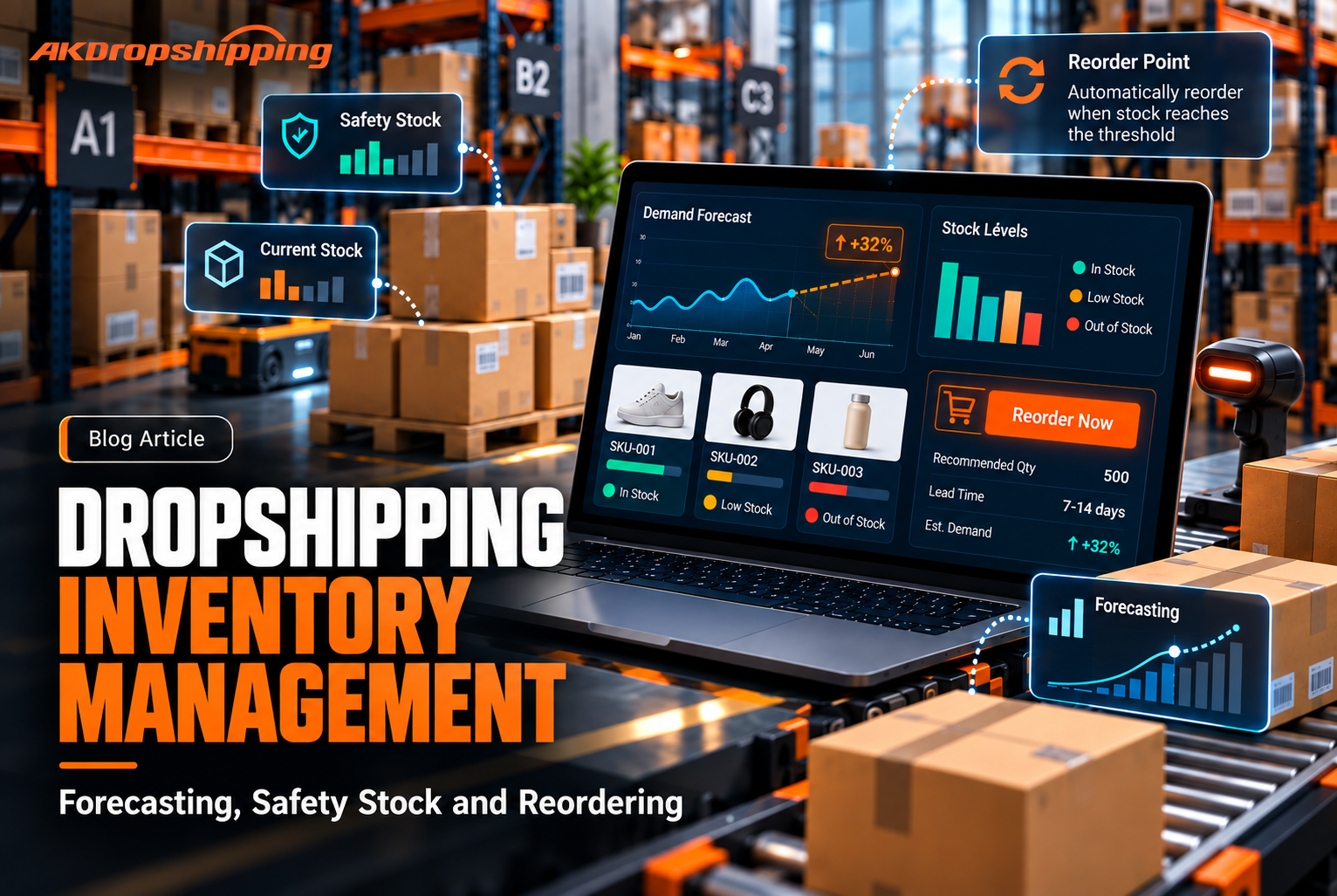
Many new e-commerce sellers enter dropshipping believing it completely eliminates inventory problems. In reality, it simply changes where and how you manage them. Even if products are stored by suppliers or fulfillment warehouses, you still need full control over what is available, what has been reserved, what is in transit, and how quickly each SKU is selling.
Effective dropshipping inventory management connects demand forecasting, supplier lead times, safety stock, reorder points, and fulfillment strategy. When done right, it prevents revenue-killing stockouts without trapping your hard-earned cash in unsold inventory.
For stores scaling from product testing to scaling bestsellers, inventory planning is the bridge between temporary success and a stable, long-term brand.

Dropshipping inventory management is the continuous tracking of product availability, sales velocity, supplier inventory, lead times, replenishment requirements, and order fulfillment status across all your sales channels.
The seller may not physically own every unit, but inventory availability still affects whether an order can be fulfilled. A product shown as available in an online store must correspond to realistic supplier or warehouse availability.
A pure on-demand dropshipping model reduces upfront capital requirements, but it does not remove supply chain risk. Supplier stock levels fluctuate without warning, factory production gets delayed around holidays, and winning products frequently run out of stock while your ad campaigns are running at full tilt.
According to research published in the Harvard Business Review, supply chain visibility and proactive inventory control are direct drivers of customer retention and operating margin. For dropshippers, the key operational question isn't just "How much stock do I own?"—it is "How many sellable units can I reliably fulfill within my promised delivery window?"
As stores grow,inventory management becomes increasingly complex.
Some of the most common challenges include:
Inaccurate supplier stock levels
Long or inconsistent lead times
Sudden sales spikes
Slow-moving inventory
Variant-specific stock shortages
Inventory mismatches between suppliers and storefront
These issue become even more important when sellers operate across multiple sales channels such as Shopify, TikTok shop, Amazon, and Woocommerce.
Pure On-Demand Model: Products are purchased from the supplier only after a customer places an order on your site. This minimizes financial risk but leaves you vulnerable to sudden stockouts, fluctuating supplier pricing, and longer processing times.
Pre-Stocked Model: You purchase bulk inventory of proven winners upfront and store them in a fulfillment center. This drastically speeds up delivery and lowers unit costs, but introduces holding risk.
Hybrid Model (Best Practice): You test new products using on-demand dropshipping. Once a SKU proves consistent sales velocity, you transition it into pre-stocked bulk inventory at a private warehouse to optimize shipping speeds and margins.
Inventory ownership and inventory responsibility are not always the same. A supplier may physically hold the products, while the seller remains responsible for communicating realistic availability to customers.
This is why inventory visibility should include available stock, reserved stock, inbound inventory, supplier availability, and expected replenishment dates rather than relying on a single stock number.
The objective is to maintain enough inventory to support expected demand and absorb reasonable uncertainty without creating excessive unsold stock.
This balance becomes particularly important for products with seasonal demand, high advertising spend, long supplier lead times, or high minimum order quantities.
Successful inventory management starts with accurate data.
Rather than monitoring every possible metric, sellers should focus on the inventory KPIs that directly affect product availability, replenishment decisions, and customer satisfaction.
Available inventory refers to units can immediately be allocated to new orders.
Reserved inventory has already been committed to existing customer orders and should not be counted as available stock.
In-transit inventory includes products that have been purchased or shipped but have not yet arrived at the warehouse.
Separating these categories prevents overselling and provides a more accurate picture of actual stock availability.
Sales velocity shows how quickly an SKU is moving. A product selling 30 units per day requires a very different replenishment strategy than one selling 2 units per day.
Average daily sales should be calculated at SKU or variant level whenever possible because product-level averages can hide differences between colors, sizes, bundles, or markets.
Lead time refers to the total time required to replenish inventory.
This typically includes:
Supplier processing time
Production time
Transportation time
Warehouse receiving time
Reliable lead-time data is essential because reorder decisions depend on how quickly inventory can be replenished.
A supplier with a consistent seven-day lead time may be easier to manage than one that averages five days but occasionally takes two weeks.
These metrics help measure inventory performance from the customer's perspective.
Stockout rate measures how often products become unavailable.
Fill rate measures how much customer demand can be fulfilled immediately.
Backorder rate measures how frequently customers must wait for inventory to become available.
Together, these metrics reveal whether inventory planning is effectively supporting customer demand.
Inventory turnover measures how frequently inventory is sold and replenished during a given period. A higher turnover rate generally indicates healthy product demand and efficient inventory utilization.
Days of inventory on hand estimates how long your current inventory can support sales before replenishment is required.
These metrics are particularly useful when deciding whether a product should remain purely on-demand or move into pre-stocking.
Forecasting demand without accounting for product losses can create inaccurate inventory plans.
Monitor:
Return rates
Order cancellation rates
Product defect rates
Quality inspection failure rates
For example, if a product generates 1,000 monthly orders but 8% are returned or rejected due to quality issues, actual inventory requirements may differ significantly from raw sales numbers.
This is one reason many growing stores implement product inspections before inventory enters fulfillment warehouses.
| Metric | What It Shows | Why It Matters |
| Sales Velocity | Units sold over time | Supports demand forecasting |
| Lead Time | Time required to replenish | Determines reorder timing |
| Stockout Rate | Frequency of inventory shortages | Indicates fulfillment risk |
| Days of Inventory | Estimated inventory coverage | Helps prevent overstocking |
| Fill Rate | Demand fulfilled from available stock | Measures service performance |
| Return Rate | Products coming back | Affects inventory planning |
Accurate demand forecasting is one of the most important parts of dropshipping inventory management. While no forecast will ever be perfect, a structured forecasting process helps sellers reduce stockouts, improve cash flow, and make better replenishment decisions.
According to the inventory planning guidelines from Oracle, demand forecasting should work together with safety stock and reorder point planning rather than being treated as a separate activity.
Forecasting should begin with actual sales data rather than total store revenue. SKU-level history reveals which products, variants, countries, and channels are generating consistent demand. Remove cancelled orders and obvious data errors before calculating the baseline.
A sudden sales increase may come from a successful advertisement, a holiday, a temporary influencer campaign, or a genuine long-term trend.
Treating every sales spike as permanent demand can cause overstocking. Conversely, ignoring a sustained upward trend can lead to stockouts.
For products with relatively consistent sales patterns, a simple moving average often provides a reliable forecasting baseline.
Forecast demand = Average sales over the selected historical periods
For example, if a SKU sold 18, 20, 22, and 20 units per day over four comparable periods, the average baseline would be 20 units per day.
When demand is changing, recent sales may deserve greater weight. A weighted moving average gives newer periods more influence than older data.
This is useful when a product is gradually accelerating rather than remaining stable.
New products lack sufficient historical data, so sellers should avoid treating early test results as a long-term forecast.
Comparable products, small advertising tests, supplier availability, and early conversion data can provide an initial planning baseline. The forecast should then be updated as more orders accumulate.
Instead of relying on one number, build three scenarios:
| Scenario | Planning Purpose |
| Base | Expected demand under normal conditions |
| Upside | Higher demand from successful promotion or viral growth |
| Downside | Lower demand or weaker conversion or reduced traffic |
This makes inventory decisions more resilient when actual sales differ from the initial forecast.
Demand patterns often vary significantly across markets and sales channels.
For example:
A product may perform strongly in the United States but weakly in Europe.
TikTok Shop demand may differ from Shopify demand.
One color variant may account for most sales volume.
Breaking forecasts down by SKU, market, and channel improves replenishment accuracy and reduces inventory imbalances.
A forecast should be treated as a working model rather than a permanent number. Compare forecast demand with actual sales and revise assumptions when the error becomes persistent.
Oracle's inventory planning documentation similarly connects demand history and forecasting with replenishment decisions and reorder-point planning.
For a product averaging 20 units per day, a seller could initially forecast 20 units of daily demand. If a promotion is expected to increase sales materially, the upside scenario might use a higher planning figure rather than assuming the historical average will remain unchanged.
The important point is consistency: use the same measurement period, distinguish promotional demand from normal demand, and update the forecast as actual order data becomes available.
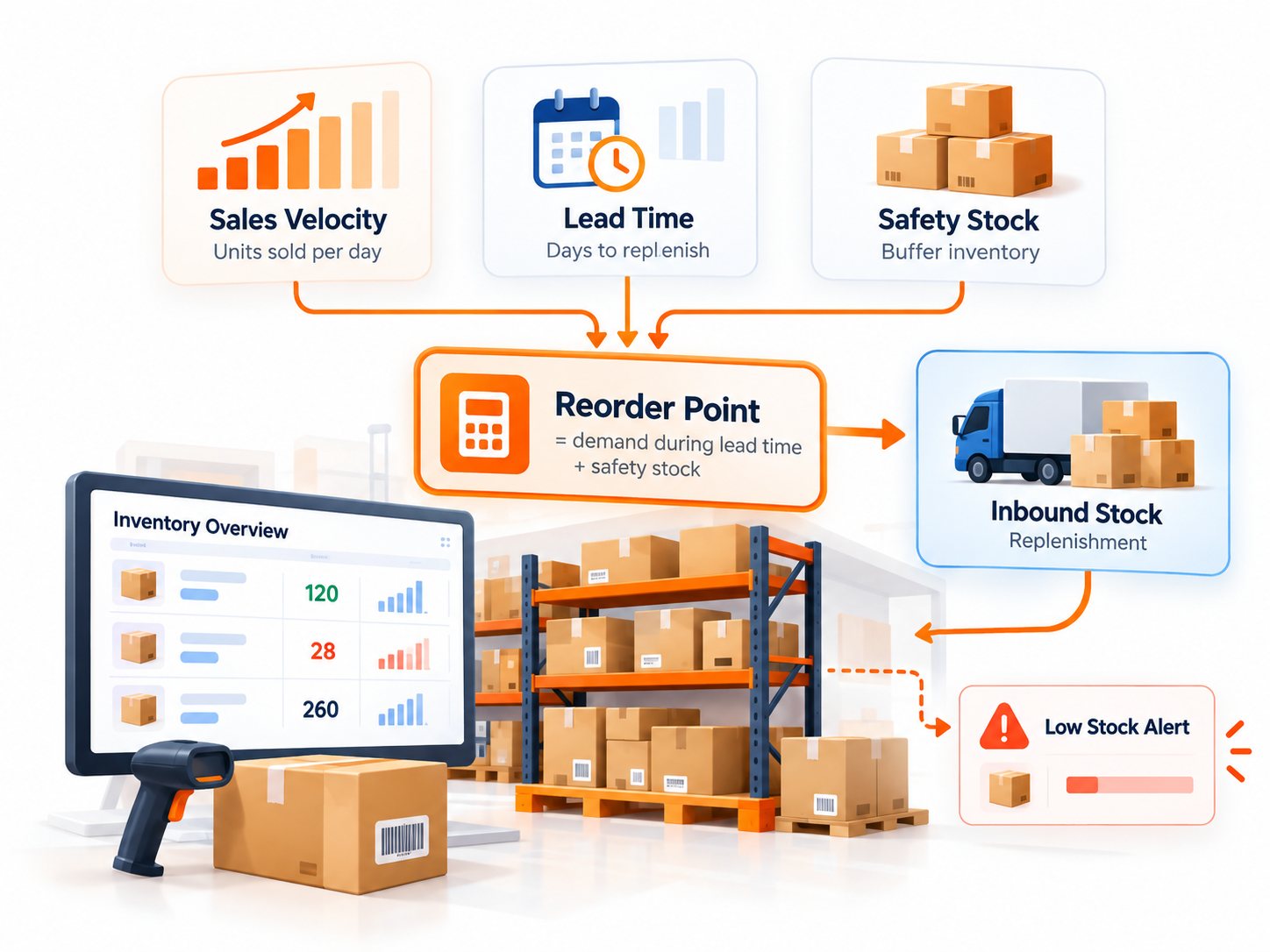
Safety stock is additional inventory held as a buffer against unexpected demand or supply variability. IBM describes safety stock as extra inventory used to reduce stockout risk caused by demand, supply, or manufacturing variability.
Many sellers assume dropshipping eliminates inventory concerns. However, once a product begins generating consistent sales, inventory availability becomes a competitive advantage.
Safety stock helps sellers:
Prevent stockouts during sales spikes
Reduce fulfillment delays
Protect advertising momentum
Improve customer experience
Maintain more stable inventory levels
The challenge is finding the right balance. Too little safety stock increases stockout risk, while too much inventory ties up cash and increases storage costs.
A practical basic formula is:
Safety Stock = (Maximum Daily Sales × Maximum Lead Time) − (Average Daily Sales × Average Lead Time)
For example:
| Variable | Value |
| Maximum Daily Sales | 30 units |
| Maximum Lead Time | 12 days |
| Average Daily Sales | 20 units |
| Average Lead Time | 10 days |
Safety Stock = (30 × 12) − (20 × 10) = 160 units
This is a simplified planning method rather than a universal formula. More advanced inventory systems can incorporate demand variability, lead-time history, and service levels.
A reorder point identifies the inventory level at which a replenishment order should be placed.
Instead of waiting until inventory reaches zero, sellers reorder early enough for new inventory to arrive before existing stock runs out.
The basic reorder point is:
Reorder Point = (Average Daily Sales × Average Lead Time) + Safety Stock
Using the previous example:
| Variable | Value |
| Average Daily Sales | 20 units |
| Average Lead Time | 10 days |
| Safety Stock | 160 units |
Reorder Point = (20 × 10) + 160 = 360 units
This means a replenishment order should be placed when available inventory reaches 360 units.
As explained in Oracle's documentation, reorder points combine forecast demand during lead time with safety stock to maintain service levels while minimizing stockout risk.
Suppose you currently have 400 sellable units of a product in stock and your calculated reorder point is 360 units.
Although inventory has not yet run out, you are already approaching the replenishment threshold.
If your supplier requires ten days to restock inventory, waiting until inventory reaches zero would almost certainly create fulfillment delays and lost sales.
The reorder point acts as an early warning system, allowing inventory to be replenished before customers experience stockouts.
Minimum order quantity affects the economics of replenishment. A supplier may require 100, 500, or more units per order, meaning the calculated reorder quantity cannot always match the exact demand forecast.
Order frequency also matters. Frequent small replenishment orders may reduce excess stock but increase ordering and shipping costs.
Minimum and maximum inventory levels can simplify operational decisions for stable products. The minimum level can trigger replenishment, while the maximum level limits how much stock is accumulated after replenishment.
The biggest mistake is treating an estimate as an exact prediction. Demand, lead time, promotions, returns, and supplier performance can all change.
A formula provides a consistent decision framework; it does not eliminate uncertainty.
Inventory formulas are only effective when supported by a consistent operational process.
A structured reordering workflow helps sellers identify potential stock shortages early and respond before they impact customers.
Group products into fast-, medium-, and slow-moving categories. Fast-moving products deserve closer monitoring because a small forecasting error can become a stockout quickly.
Not every SKU needs the same safety stock percentage or review frequency. High-volume products with long lead times require different rules from low-volume products that can remain on-demand.
Replenishment decisions should consider stock already ordered but not yet received. Otherwise, sellers may place unnecessary duplicate orders.
Supplier lead times, warehouse receiving schedules, and transportation times should be considered together. A product may be technically available from a supplier but still unavailable to the customer if the inbound process is too slow.
Automated alerts can flag declining inventory, delayed purchase orders, or unusual sales spikes before they become fulfillment problems. A suitable Dropshipping Automation App can also reduce manual monitoring when sellers manage many SKUs or channels.
Advertising should not operate independently from inventory availability. If a product is approaching its stockout threshold, sellers can reduce traffic to that SKU, shift budget toward alternatives, or temporarily pause campaigns.
Bundles can create hidden inventory dependencies. A bundle may appear available while one component is actually out of stock.
Variant-level inventory is equally important when customers can choose different sizes, colors, or configurations.
Slow-moving inventory should be reviewed separately from fast sellers. Seasonal products may require an exit plan before demand disappears, while obsolete products may need markdowns, bundles, or discontinuation.
A practical weekly review should examine sales velocity, supplier stock, lead-time changes, open purchase orders, inbound inventory, stockout risk, advertising activity, and slow-moving SKUs.
Inventory planning starts with dependable product sourcing. Supplier availability, processing time, MOQ, and replenishment capability should be considered before a product becomes a major advertising investment.
Quality inspection helps prevent defective products from entering sellable inventory. This matters because inventory quantity alone does not indicate how many units can actually be fulfilled to customers.
Once a product has demonstrated consistent demand, pre-stocking selected units can shorten the fulfillment path and make inventory planning more predictable.
This approach is especially relevant for sellers moving from pure on-demand fulfillment toward a hybrid inventory model.
Inventory information becomes more useful when it can be connected with order activity. Automatic stock updates can reduce the gap between warehouse availability and storefront availability. For sellers managing multiple sales channels, this type of automation can reduce manual inventory checks.
Pre-stocking proven products can shorten the fulfillment process because orders can be processed from inventory that is already available in the warehouse. Instead of purchasing and preparing each order after the customer checks out, sellers can maintain selected quantities of fast-moving SKUs and fulfill them as orders arrive.
This approach can be especially useful for products with stable demand, predictable sales velocity, and sufficient order volume to justify holding inventory. The key is to pre-stock based on actual sales data and replenishment lead times rather than simply increasing inventory across the entire catalog.
A practical progression is to test products with on-demand fulfillment first, measure actual demand, identify repeatable winners, and then pre-stock selected SKUs.
For sellers already using yampi dropshipping, this type of product-testing workflow can be combined with inventory decisions based on actual order performance rather than assumptions about future demand.
Effective dropshipping inventory management is not about keeping as much stock as possible. It is about maintaining the right level of product availability while protecting cash flow and reducing fulfillment risk. Sellers should monitor SKU-level sales velocity, supplier lead time, stock status, returns, and demand changes, then use those inputs to establish safety stock and reorder points.
For products that are still being tested, on-demand fulfillment can limit inventory exposure. For proven bestsellers, pre-stocking and warehouse fulfillment can create a more predictable replenishment cycle. A hybrid approach allows sellers to use actual sales data to determine when inventory investment is justified.
Yes. Even when a supplier owns the stock, the seller still depends on accurate availability, lead times, variant counts, and replenishment information. Inventory management becomes more important when sales grow, several channels share stock, or proven products are pre-stocked to improve processing speed and delivery consistency.
Start with SKU-level sales history, remove obvious one-time anomalies, and compare recent sales velocity with seasonal and promotional effects. Use a simple moving or weighted average for established products. For new products, use comparable items and small tests, then update the forecast frequently as actual order data accumulates.
Safety stock is extra inventory kept to absorb unexpected demand or supplier and shipping delays. It is most relevant when a seller pre-stocks proven products or reserves supplier inventory. The right amount depends on demand variability, lead-time variability, service targets, margins, and the financial risk of holding excess stock.
A basic reorder point equals expected demand during supplier lead time plus safety stock. Multiply average daily sales by average lead time, then add the chosen buffer. Recalculate the result when sales velocity, production time, inbound shipping time, MOQ, seasonality, or promotional plans materially change.
Fast-selling or high-risk SKUs may need daily monitoring, while stable low-volume products can be reviewed weekly. Review frequency should reflect sales velocity, lead time, stockout cost, supplier reliability, and promotion schedules. Use alerts for low stock, delayed inbound orders, unusual demand spikes, and inventory mismatches.
Maintain SKU-level stock visibility, define a primary and backup supplier, include in-transit inventory in reorder decisions, and confirm realistic handling times. Set low-stock alerts and pause advertising before availability becomes critical. Test substitute products or shipping routes in advance instead of switching suppliers only after a stockout occurs.