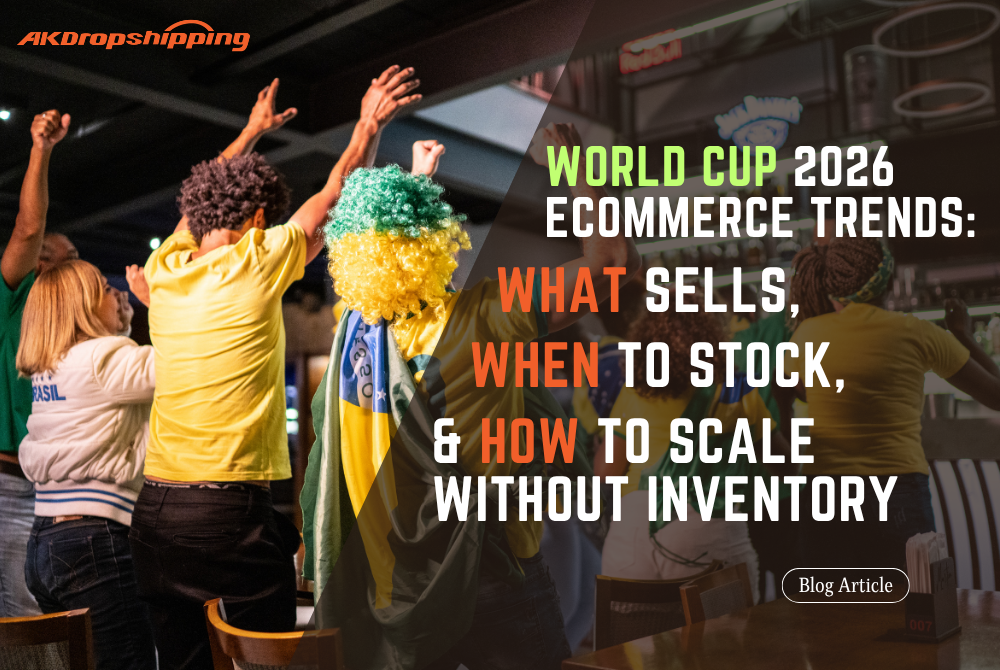
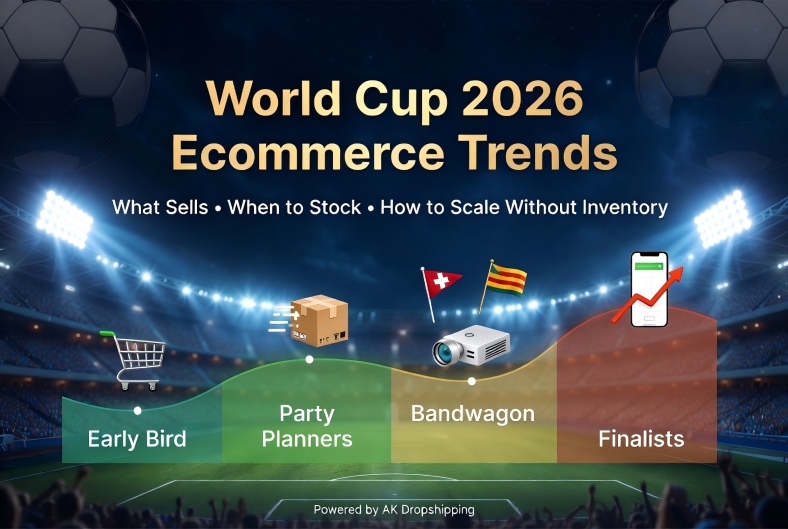
The 2026 FIFA World Cup runs June 11 to July 19, 2026, hosted across the USA, Canada, and Mexico—a compressed, hype-driven window where demand spikes in predictable waves. This guide breaks down (1) when fans buy, (2) what categories reliably surge, and (3) how to "stock" and scale without holding inventory using a dropshipping operating model with AK Dropshipping.
What triggers demand: roster rumors, qualification chatter, "first-time host region" excitement, early trip planning.
What sells best: evergreen fan lifestyle items and "home setup" upgrades that don't rely on knowing finalists.
Merchants win here by:
Launching non-team-specific designs (soccer-themed, "watch party" focused),
Publishing SEO pages early so they age/index before the spike (helpful for Google's trust signals)
What triggers demand: tournament schedule awareness + watch-party planning + urgency right before kickoff (June 11).
What sells best: party bundles (higher AOV), fast-to-ship items, and impulse accessories.
Operational priority: confirm cut-off dates and set customer expectations clearly (shipping ETA messaging reduces disputes).
What triggers demand: surprise wins, memes, viral player moments, national pride momentum.
What sells best: "identity" products + quick-turn items that can react to storylines.
Marketing priority: speed of creative iteration (new angles every 24–72 hours).
What triggers demand: finalists announced, "we're going to the final" travel, and post-win celebration.
What sells best: finalist-specific designs, champions-themed collectibles, and "commemorative" items.
Risk: late shipping. If delivery can't happen before the final (July 19), position products as keepsakes, not "game-day use".
World Cup viewing is a social event. Products that upgrade the experience consistently perform:
Projector accessories, HDMI/streaming add-ons (where compliant)
Snack/serving solutions, themed décor, reusable cups
"Party bundle" SKUs (table cover + banners + photo props)
These are less rational and more emotional (and that's why conversion can spike):
Flags, face paint kits, themed scarves
Customizable name/number-style items (within IP-safe boundaries—avoid official marks)
Public screenings, patios, and parks drive:
Portable seating, picnic accessories
Sun/rain protection add-ons
Power/charging accessories (practical + high perceived value)
Use this quick scoring model to decide what to launch first during a short tournament window.
If your supply chain can't deliver while hype is peaking, your product is "content", not commerce.
With AK Dropshipping, the practical play is building a pre-approved SKU list that your agent/team can process fast (so you're not sourcing from scratch each time).
World Cup demand often starts on social, then converts on-site.
High-contrast designs (camera-friendly)
"Group identity" items (matching hats/shirts for friends)
Smaller items let you:
Offer free/low-cost shipping thresholds
Reduce damage rates
Keep delivery ETAs more predictable
Scarcity isn't only "limited stock"—it's also "limited time".
Time-box offers around match dates
"Country pride" collections (IP-safe, no official logos)
You don't need years of store history to forecast World Cup spikes—you need signals.
Use Google Trends to validate rising topics and seasonality, and to shape content calendars and landing pages. (developers.google.com)
Tip: compare generic terms ("watch party", "soccer decorations", "flag") vs country keywords to spot where demand is broad vs team-driven.
Find what creators are pushing, which hooks work, and what formats repeat. Your goal: identify product angles that already have attention and convert them into landing pages + bundles.
Use Meta's ad transparency database to see what competitors are actively running and how their offers are structured (bundle, discount, shipping promise).
You're not copying creatives—you're benchmarking angles and offer math.
Even without your own data, suppliers/agents often see:
SKU reorder frequency
Spike in "quote requests"
Shipping line congestion patterns
This is where an experienced partner matters. If you're building an inventory-free plan, align with a team that can tell you what's heating up before your ads get expensive.
"Stocking" without inventory means pre-deciding what you'll sell and how it will ship.
Build a shortlist of World Cup-ready SKUs
Pre-confirm packaging options, variants, and QC checks
Agree on a processing-time SLA (service-level agreement) so you can run time-sensitive promos
If you're still learning the model fundamentals, anchor your team internally with: What Is Dropshipping? A Complete Guide to Modern E-Commerce.
And if you're implementing from scratch, use How to Start Dropshipping: A Step-by-Step Entrepreneur's Guide.
Set up at least two shipping options:
"Best value" line (default)
"Priority" line (for Wave 2–4 urgency)
Then add cut-off messaging sitewide:
"Order by X date to receive before the semifinal/final"
If after cut-off: "Arrives after the match—perfect as a keepsake"
For partner selection and risk control, link your ops team to How to Find a Reliable Dropshipping Agent in China.
Best for Wave 1–2:
Countdown timer to kickoff (June 11)
Early-bird bundles (higher AOV, simpler fulfillment)
Email/SMS capture: "get notified when country collections drop"
Best for Wave 3–4:
"Top teams right now" collections
"Underdog stories" collection
"Finalists gear" collection (swap hero banners fast)
During watch parties, traffic is heavily mobile. Prioritize:
fast product pages
minimal popups
accelerated checkouts
clear shipping ETA above the fold
External reference worth using for your research workflow: Google Trends documentation by Google Search Central (to validate how Trends supports content planning).
If processing slips, everything breaks (ETA, support load, refunds). Track daily.
Define "on-time" by your promise (not the carrier's marketing). Watch by shipping line.
Track tickets per 100 orders. Spikes usually mean:
Unclear ETA language
Sizing/variant confusion
Tracking latency
World Cup buyers are impatient. If refunds rise:
Tighten pre-purchase expectation setting
Improve QC for high-return SKUs
Adjust creatives that overpromise
Use this simple dashboard view (example targets; adjust to your store):
| KPI (Daily) | Green | Yellow | Red | What to do in "Red" |
| Processing time | ≤ 24h | 24–48h | >48h | Pause new ads on slow SKUs; switch lines; simplify variants |
| On-time delivery | ≥ 92% | 85–92% | <85% | Update cut-off banners; push "keepsake" messaging |
| Tickets / 100 orders | ≤ 6 | 7-10 | >10 | Add ETA FAQ, proactive tracking emails, clearer PDP notes |
| Refund rate | ≤ 3% | 3-6% | >6% | QC tightening + product page expectation reset |
Running a dropshipping store during a high-intensity event like the World Cup isn't just about finding the right products—it's about having the right operational backbone behind you.
AK Dropshipping is a China-based full-service dropshipping partner built for exactly this kind of compressed, high-stakes selling window. From product sourcing and quality inspection to custom packaging and global fulfillment, AK Dropshipping handles the supply chain so you can stay focused on marketing, creatives, and scaling.
AK Dropshipping positions itself as a free dropshipping supplier platform with no hidden fees, letting sellers source products, request quotes, and fulfill orders through an all-in-one system. Your primary costs are typically the product cost + shipping + any selected service add-ons (e.g., private labeling/customization) depending on your needs.
AK Dropshipping provides an end-to-end fulfillment workflow: product sourcing and quotes, variant mapping, order processing, quality inspection, packing, global shipping, and tracking updates—designed to help you scale without holding inventory.
Yes. AK Dropshipping offers private labeling/white labeling services where you can submit your logo or packaging requirements, confirm designs/samples, and ship to customers under your brand experience (subject to product and feasibility).
AK's service page indicates it addresses operational questions like whether AK branding appears on packages and includes information about return and refund policies—these details should be confirmed for your specific product and shipping route before scaling paid traffic.